

Commentary
Alexander Baunov
{
  "authors": [
    "Alexander Baunov"
  ],
  "type": "commentary",
  "blog": "Carnegie Politika",
  "centerAffiliationAll": "",
  "centers": [
    "Carnegie Endowment for International Peace",
    "Carnegie Russia Eurasia Center"
  ],
  "englishNewsletterAll": "",
  "nonEnglishNewsletterAll": "",
  "primaryCenter": "Carnegie Russia Eurasia Center",
  "programAffiliation": "",
  "regions": [
    "Russia"
  ],
  "topics": [
    "Domestic Politics",
    "Political Reform",
    "Civil Society"
  ]
}
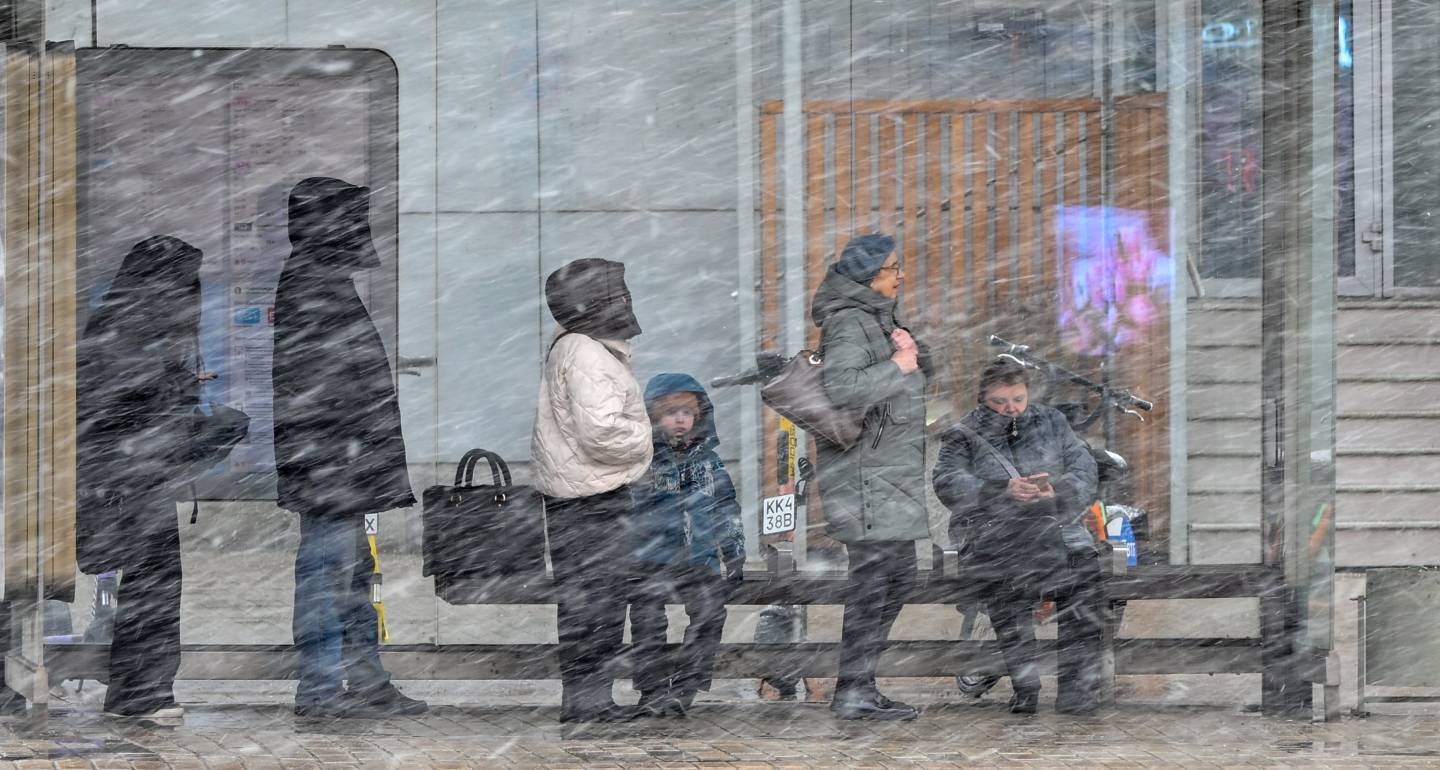
Source: Getty
The Russian regime is now visibly motivated by fear.
Something in the air has changed in Russia. Now even loyalists complain about the mounting restrictions and repression, and once-upbeat businesspeople are now despondent.
What we are witnessing is three related processes. First, attitudes toward President Vladimir Putin are changing. Second, economic optimism and the associated everyday patriotism, which celebrates survival rather than development (people are simply grateful to be alive) are fading. And finally, Russian people are realizing the impossibility of winning a war that has minimized their country’s advantages.
Preparations for Moscow’s annual Victory Day parade on May 9 marking the end of World War II are markedly different this year. In previous years, rehearsals began in April. This year, the parade is being held without rehearsals or military hardware, and with only a small number of personnel. Most importantly, Putin will spend less time up on an exposed public tribune in Red Square at a time known well in advance. The security implications are clear. A military parade is intended as a demonstration of strength and bravery, but if it is held furtively, without rehearsals, and with the internet jammed (to reduce the chances of a Ukrainian attack drone being able to navigate to the site), it demonstrates nothing but fear and weakness.
Victors are not judged, the Soviet dictator Joseph Stalin liked to say. But non-victors can be—and people are beginning to judge Putin. The entire state apparatus, government, parliament, media, church, and the intelligence services are all still trying to cover up the mistake Putin made back in 2022 when he launched the full-scale invasion of Ukraine—but they are increasingly failing.
Putin is losing his magic. Power remains undivided in his hands, but its spell is fading. His true form is also emerging. People increasingly see an old man with scrawny legs and shrinking muscles under his baggy suit. The pre-war Putin, bare-chested and riding a horse, is now impossible to imagine.
To match his appearance, his speech is also changing, becoming confused and sometimes meaningless. He often veers off topic and struggles to express himself. Sometimes he strays into the fictional realm, talking about “foreign agents” who are safe in Russia so long as they reveal the sources of their funding—even though the reality is very different, not least thanks to a recent law signed by the president himself. Putin no longer inspires confidence, even among the ruling elite. Instead of a guarantor, he is becoming a liability.
The mood right now is strikingly different from a year ago. Russian society seems to have come full circle, from the worst fears at the start of the “special military operation” through the euphoria of survival into a new cycle of doubt and fear. Even Putin’s official approval rating has noticeably declined.
Since the summer of 2022, people have largely adjusted to the war. After the initial shock of the invasion, mobilization, the exodus of Western brands and emigration of friends and celebrities, a wave of repression and prohibitions, and Yevgeny Prigozhin’s mutiny, from 2024, a new prosperity emerged from the ruins of the old life, and with it, a mood of “everyday patriotism,” a sense of fragile calm, and even the return of optimism.
It had become clear that Russia could not easily be excluded from the global economy. The army, though it had failed to pull off a blitzkrieg, was no longer retreating, but on the offensive once again. The ruble hadn’t collapsed, and the state hadn’t closed its borders or frozen people’s deposits. Industrial growth, unemployment, and wages were performing better than pre-war forecasts. The Global South hadn’t turned its back on Russia, and revived relations with U.S. President Donald Trump brought Russia back into the world of high-stakes diplomacy.
The regime has succeeded in making society feel that they are both in the same boat: a single ship on which everyone will either be saved or killed. After all, if the captain’s bridge goes down, the rest of the ship has already gone under.
Everyday patriotism rejoiced in the preservation of familiar ways of life, despite the circumstances. Even for those opposed to the war, economic survival became a source of pride, giving them a kind of common ground with those who support the war. But in the spring of 2026, this shared sentiment no longer exists.
When it launched its full-scale invasion of Ukraine, the Russian regime destroyed previous social tradeoffs with the Russian people, but swiftly offered them a new one: you can live outside of the war, but you cannot be against it. For those who accepted the offer (though consent was not exactly sought), the regime was prepared to allow a way of life close to their pre-war existence.
This exchange was accepted by many, if not most: some out of desperation, others out of genuine indifference to the misfortunes of others. But by the spring of 2026, the Russian regime had unceremoniously violated the terms of this compromise agreement one after another, and now society is angry. People did not agree to ignore the war only to become the target of prohibitions and repressions themselves, and now feel cheated and deceived.
The authorities have banned popular foreign messaging apps like Whatsapp and Telegram on the grounds that they are non-transparent, and are trying to make everyone use the homegrown Max app instead. The implication that interactions via Max are, in contrast, transparent, has not gone unnoticed, and people feel their privacy has been rudely invaded. Inhabitants of unfree countries are particularly sensitive to this latter point, as personal space is all they have left once the state has taken over public space.
Since messaging apps are also used by people to agree on paid services, there are also suspicions among the general public that this is another way for the state to go after their money. That theory has been compounded by fiscal measures in recent months, such as the VAT increase from 20 percent to 22 percent, and the requirement to provide a taxpayer identification number for transfers made through the Faster Payments system (which previously only required the recipient’s phone number).
The economic mood is changing too. Military growth no longer means increased income and opportunities. The tone of Putin’s meeting on economic issues on April 15 was very different from previous ones between the president and the economic bloc.
Government economists, who until recently felt far more confident than the military brass, suddenly discovered how it feels to be a Russian general: negative growth in the first months of 2026, judging by the commander-in-chief’s somber tone, amounts to a retreat.
A recent turning point was a viral Instagram post by the Russian model and blogger Victoria Bonya in which she criticized the Russian authorities, told Putin “there is a lot that you don’t know,” and listed a range of problems she said officials are too scared to bring up with Putin, including the internet blackouts.
First, it was addressed directly to Putin, not to lower-level agencies like Roskomnadzor, thereby indirectly identifying the president himself as the source of the problems.
Second, the entire concept of the “special military operation” was built on the premise that the president has access to information that ordinary people do not, such as plans for an imminent attack from elsewhere. Bonya’s message inverses that premise: we, the people, know about the country’s problems with the internet and everything else, but the president doesn’t. And perhaps, therefore, he also doesn’t really know what he’s talking about where the war is concerned. Maybe he didn’t even know when he started the whole thing.
Meanwhile, Putin has confirmed that he personally approves of the online restrictions, saying that “ensuring people’s safety will always be a priority.” He is once again pushing the classic authoritarian trade-off of freedom for security—but that tried-and-tested mechanism is stalling. People are literally saying that they must be able to access the internet, even if that increases the risks from Ukrainian drones. So if ordinary people are willing to tolerate the dangers that come with their rights, whose security is at stake? The implication is that they are being asked to trade their rights for the leader’s security.
Following Bonya’s Instagram post, Putin appeared to cautiously criticize those responsible for the slew of blocks and bans. First, he recommended that the authorities communicate better with citizens, and then urged them “not to get fixated on bans.”
His reaction was unprecedented both in terms of the high-level feedback to a grassroots initiative, and also for his careful criticism of the security services, which Putin usually shields from any blame. It looks like a victory for civilian bureaucrats, though it’s likely to be temporary. Finding himself losing his balance, Putin is trying to get back on even ground before the State Duma elections in September, but the security services are already targeting people close to First Deputy Chief of Staff Sergei Kiriyenko, who has led the pushback against the bans.
The real culprits behind the shift in mood in Russia are not the security services, rebellious influencers, or rational elements within the regime. The Ukrainian armed forces’ ability to deliver devastating blows to oil refineries, storage facilities, and other sites across almost all of Russia has forced the Russian regime to break the terms of its arrangement with a loyal majority willing to overlook the war.
Ukraine’s fierce resistance, coupled with a new military-industrial revolution, has created a military stalemate and turned the front into a kill zone. Even the most “patriotic” pro-war Russian bloggers have stopped calling for a general mobilization because it would only mean more people killed by drones.
Similarly, the resilience of Ukraine’s civilian population has dashed Russia’s hopes of achieving a victory behind the front lines by bombing Ukraine’s energy infrastructure to freeze the population into submission. Instead of taking to the streets to overthrow President Volodymyr Zelensky, Ukrainians focused on procuring generators.
Moscow’s calculation that the Western economy would collapse first in a head-on collision also proved false. The very arena in which Russia had prepared to demonstrate its advantages—military superiority and economic stability—has become a showcase for its vulnerabilities. The Russian government is now visibly motivated by fear. The fading magic has had to be replaced with coercion, and the Russian intelligence services are drunk on power.
The outbreak of war proper in 2022 forced the various elite groups to unite in order to survive. Now the uncertainty over the war’s outcome is causing cracks in the regime’s foundation and ceiling, and the entire edifice is subsiding. Even if it survives, it will no longer look like it used to.
Researchers into the twilight eras of political periods in history will recognize that difficult-to-describe sense of fading, when the old power has not yet vanished, but has ceased to be seen as natural or self-evident.
Meanwhile, the authorities are rushing to show that everything is fine, and in doing so are making more and more mistakes, and backsliding like a car stuck in the mud. The system remains in place, but is being displaced, and is no longer seen as it once was. A shift in the public mood is beginning, opening up the most unexpected possibilities, both appealing and terrifying. In early 20th-century Russia, this feeling inspired an entire body of literature. Perhaps another will be devoted to it this century.

Senior Fellow, Editor-in-Chief, Carnegie Russia Eurasia Center
Baunov is a senior fellow and editor-in-chief at the Carnegie Russia Eurasia Center.
Recent Work
Alexander Baunov
Alexander Baunov
Carnegie does not take institutional positions on public policy issues; the views represented herein are those of the author(s) and do not necessarily reflect the views of Carnegie, its staff, or its trustees.
For all the menacing rhetoric, the Armenian prime minister remains a leader with whom Putin is prepared to interact: not as an ally, but as a partner, albeit a problematic one.
Alexander Atasuntsev
The issue is not that the president only has selective information at his disposal, but that the decision-making process consists of one person with an unshakeable vision of how the world works.

Tatiana Stanovaya
A much-discussed disagreement over internet restrictions in Russia was never an existential threat for Putin: It was about elite groups protecting their interests.

Alexandra Prokopenko
By reminding the world that Lukashenko is a threat to NATO and Ukraine, Kyiv is trying to return the focus to why the Belarusian regime needs to be contained rather than rewarded.

Artyom Shraibman

The demands of the Kremlin’s war in Ukraine, demographic problems, and public hostility toward Central Asians mean Russia does not have enough workers.
Salavat Abylkalikov