

Commentary
Dimitar Bechev, Iliriana Gjoni
{
  "authors": [
    "Dimitar Bechev"
  ],
  "type": "commentary",
  "blog": "Carnegie Politika",
  "centerAffiliationAll": "",
  "centers": [
    "Carnegie Endowment for International Peace",
    "Carnegie Russia Eurasia Center"
  ],
  "englishNewsletterAll": "",
  "nonEnglishNewsletterAll": "",
  "primaryCenter": "Carnegie Russia Eurasia Center",
  "programAffiliation": "",
  "regions": [
    "Russia",
    "Central Europe"
  ],
  "topics": [
    "EU Foreign Policy",
    "Foreign Policy",
    "Global Governance"
  ]
}
Source: Getty Images
Though Orban is gone, Putin can still count on some like-minded individuals in Central and Eastern Europe. However, they will seek to avoid open confrontation with EU institutions over Ukraine and their ties with Moscow.
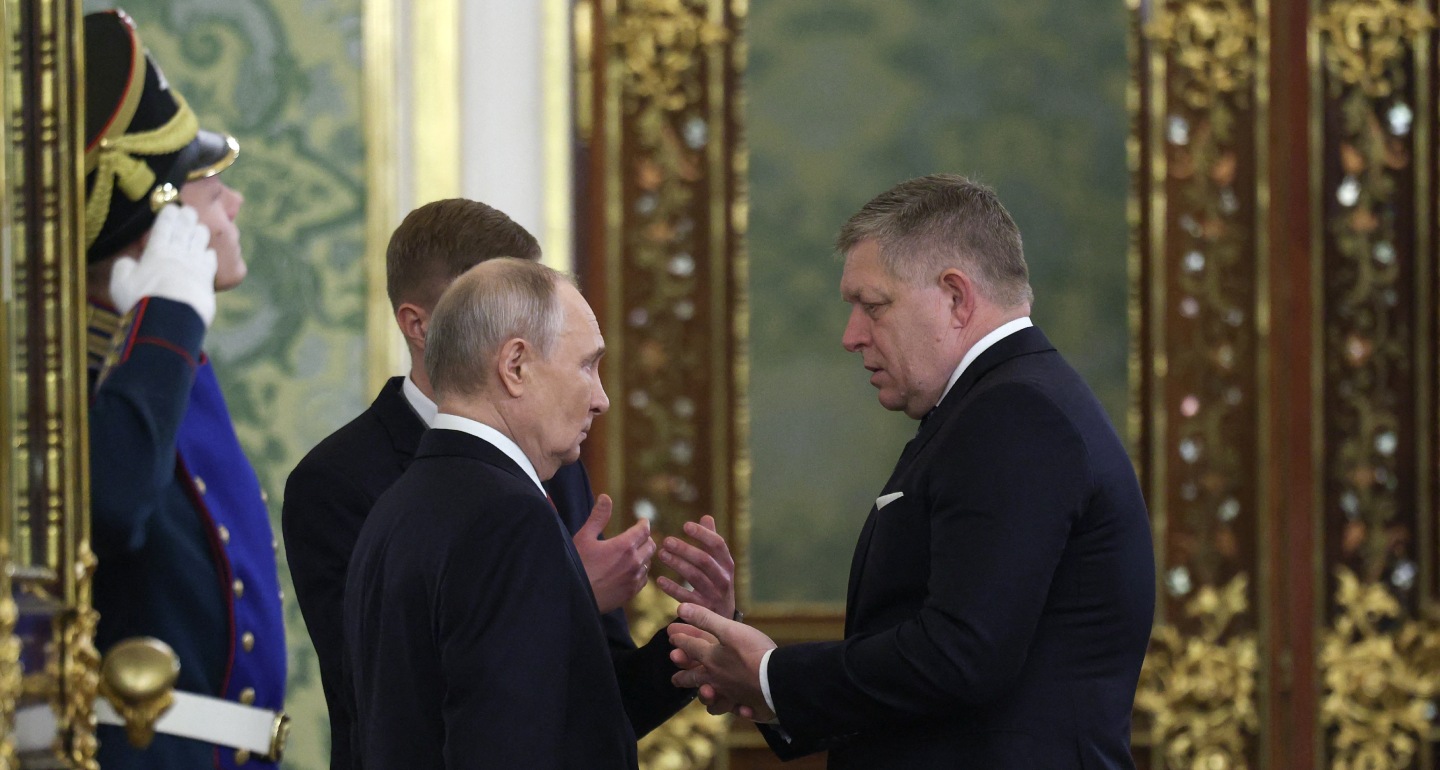
On May 9, Slovak Prime Minister Robert Fico met Russian President Vladimir Putin in Moscow to discuss energy cooperation and the war in Ukraine. The meeting highlights a broader trend in Central and Eastern Europe: Even after Viktor Orban’s fall from power in Hungary, several regional leaders continue to engage with Russia in search of economic and political advantages.
What drives that outreach is pragmatism rather than alignment with Russia’s broader geopolitical agenda. Governments in Slovakia, Bulgaria, the Czech Republic, and post-Orban Hungary are attempting to balance continued support for Ukraine and commitments rooted in EU and NATO membership with economic pressures, particularly in the energy sector. While Moscow-friendly leaders and governments are unlikely to obstruct Ukraine’s EU accession bid or fundamentally undermine European unity, they will advocate renewed channels of communication with Russia and limited restoration of economic ties. In doing so, they will piggyback on calls in Europe for launching direct negotiations with Putin, separately from the U.S.-Russia track.
Contrary to widespread expectations, Fico did not attend the military parade on Moscow’s Red Square. Instead, he laid flowers at the Tomb of the Unknown Soldier near the Kremlin walls. The symbolism mattered. Last year, Fico was the only EU leader present at the parade commemorating the eightieth anniversary of the Soviet victory over Nazi Germany in World War II.
His more restrained position this year reflected improving relations with Kyiv. Days before traveling to Moscow, Fico met with Ukrainian President Volodymyr Zelensky at the European Political Community Summit in Yerevan on May 4. Following the meeting, Zelensky said that Slovakia supported Ukraine’s EU accession process, suggesting that Bratislava would not obstruct membership negotiations in the way Orban had done in Hungary.
The two leaders also agreed to exchange visits to Bratislava and Kyiv. According to the Slovak Foreign Ministry, Fico additionally conveyed a message from Zelensky to Putin during his Moscow visit.
Slovakia increasingly appears interested in positioning itself as an intermediary between Russia, Ukraine, and the EU. Fico’s back-and-forth coincided with Putin’s own recent suggestion that the conflict in Ukraine may be entering its final phase.
Fico is bound to tread more cautiously than Orban did because he is under pressure from Brussels. In April, the European Parliament called on the European Commission to trigger the rule of law mechanism against Slovakia, similar to the measures previously applied to Hungary. If implemented, Bratislava could face the suspension of up to 19 billion euros in EU funding.
A standoff with Brussels is markedly not in Fico’s interest. Slovakia’s economic prospects are lackluster. According to both the European Commission and the IMF, the economy is expected to remain on a slow-growth path, with weak exports, subdued domestic demand, and inflation still above target. Orban’s loss of power is a cautionary tale that bread-and-butter issues trump geopolitics in the public’s minds. Fico is not scheduled to face voters until 2027, although persistent coalition tensions have fueled speculation about possible snap elections as early as this year.
A similar balancing act is already becoming visible in Bulgaria under Prime Minister Rumen Radev, who served as president of the country between 2017 and 2026.
Following the April 19 elections, which delivered a decisive victory to Radev’s Progressive Bulgaria party, the new government endorsed proposals for direct EU-Russia negotiations and framed renewed energy cooperation with Moscow as necessary for restoring Europe’s competitiveness.
At the same time, leading figures in the government have adopted a markedly more skeptical tone toward support for Ukraine. Deputy Prime Minister Ivo Hristov stated in a television interview that Bulgaria would halt exports of ammunition and weapons to Kyiv. But the government’s initial decisions suggest that rhetorical shifts may not translate into a fundamental reorientation of foreign policy.
The appointment of Velislava Petrova-Chamova as foreign minister is illustrative. A technocrat with a doctorate in microbiology from Cambridge University, she previously served in governments that strongly backed Ukraine, including the reformist administration of Kiril Petkov in 2022–2023.
Petrova-Chamova’s rhetoric has been balanced. “A strong Europe is good for Bulgaria. The country must find its active role within the EU rather than simply following others,” she said on May 11 following the EU Foreign Affairs Council meeting in Brussels. She also welcomed Radev’s decision to make his first foreign trip as prime minister to Germany. Although meeting German Chancellor Friedrich Merz on May 18, the Bulgarian prime minister said that Europe had to “play a much stronger role in diplomacy to de-escalate tensions and restore peace.”
Likewise, on May 10, Petar Vitanov, head of the Progressive Bulgaria parliamentary caucus, confirmed that Sofia would maintain the ten-year defense cooperation agreement with Ukraine signed earlier this year.
Bulgaria’s room for maneuver is limited by economic and strategic realities. Since 2022, the country has become a major supplier of ammunition to Ukraine, with total exports estimated at 6.7 billion euros between 2022 and 2026. Bulgaria has also secured approximately 3.2 billion euros through the EU’s Security Action for Europe (SAFE) program, including funding for joint drone production with Ukraine.
Radev, a former air force commander, is likely to continue supporting military modernization while simultaneously seeking to normalize selected economic ties with Moscow. Energy policy will be central to these efforts. Radev has advocated resuming imports of Russian crude oil from Novorossiysk, and the future status of the Lukoil-owned Neftochim refinery remains under discussion following its placement under state administration because of U.S. sanctions.
Natural gas policy is more complicated. Bulgaria stopped receiving Russian gas in 2022 after a dispute with Gazprom, and subsequently signed a controversial agreement with Türkiye’s BOTAS to offset lost supplies. Renegotiating that arrangement is now a government priority.
Even so, Sofia continues to support the so-called Vertical Corridor project designed to transport gas from Greece to Moldova and Ukraine, reflecting Bulgaria’s effort to maintain some flexibility rather than fully restore dependence on Russia.
Hungary’s parliamentary elections on April 12 marked the most significant political shift in the region. The victory of Peter Magyar’s Tisza party ended more than a decade of Viktor Orban’s rule and initiated a recalibration of Budapest’s Russia policy.
Since taking office, Magyar has moved quickly to repair relations with Brussels. Hungary lifted its veto on the 90 billion euro EU aid package for Ukraine and supported the bloc’s twentieth sanctions package against Russia.
The new government has also announced investigations into previous agreements with Russian entities. Economy and Energy Minister Istvan Kapitany stated that Budapest would review both the financing and implementation of the 2013 agreement with Russia’s state atomic energy corporation, Rosatom, to expand Hungary’s Paks nuclear power plant.
At the same time, Hungary is unlikely to sever ties with Moscow entirely. Magyar has repeatedly emphasized the importance of stable oil and gas imports and has signaled openness to eventual talks with Putin under appropriate conditions. The decision to unblock EU assistance to Ukraine came shortly after Russian oil deliveries through the Druzhba pipeline resumed.
Budapest will likely not withdraw a legal challenge before the European Court of Justice against the EU’s REPowerEU regulation mandating a complete phaseout of Russian gas imports by 2027. Hungary argues that Brussels improperly used trade competencies to circumvent unanimity requirements normally governing sanctions and energy policy. The current Hungarian gas contract with Gazprom runs through 2036.
On this issue, Hungary is likely to find support from both Slovakia and Bulgaria, which continue to depend heavily on energy transit routes connected to Russia.
The Czech Republic under Prime Minister Andrej Babis has similarly adopted a more cautious tone on Ukraine while avoiding a broader break with Western institutions. Babis has argued against open-ended support for Kyiv and called for a negotiated settlement with Russia. Nevertheless, he rejected demands from the far-right Freedom and Direct Democracy party, a member of the governing coalition, to withdraw from the EU and NATO.
Prague has also preserved its leading role in the Ammunition Initiative supporting Ukraine, although the government now prefers to coordinate procurement efforts without substantially increasing direct state financing. Czech arms exports to Ukraine in 2022–2026 are estimated at approximately 1.23 billion euros.
Though Orban is gone, Putin can still count on some like-minded individuals in Central and Eastern Europe. However, the likes of Fico, Radev, Babis, and—to a lesser degree—Magyar pursue a transactional approach to Russia, as opposed to a coherent strategy aligned with that of the Kremlin. As a recent example, earlier this week, Hungary, Slovakia, and Bulgaria declined to join the special tribunal to prosecute Putin for the crime of aggression, although the EU as a whole is among the founders. However, they will seek to avoid open confrontation with EU institutions over Ukraine and/or their ties with Moscow.
Still, the balancing strategy they favor carries some risk for European cohesion. Russia will continue to exploit visible disagreements within the EU, particularly on sanctions and energy policy. In countries like Slovakia, Bulgaria, and the Czech Republic, where Russia is a divisive issue, any high-profile conciliatory move toward Moscow may trigger protests and internal polarization. Such a scenario would again provide fertile ground for Russian actors to deploy the standard propaganda and disinformation toolkit with the aim of undermining the EU from the inside.

Senior Fellow, Carnegie Europe
Dimitar Bechev is a senior fellow at Carnegie Europe, where he focuses on EU enlargement, the Western Balkans, and Eastern Europe.
Recent Work

Dimitar Bechev, Iliriana Gjoni
Dimitar Bechev
Carnegie does not take institutional positions on public policy issues; the views represented herein are those of the author(s) and do not necessarily reflect the views of Carnegie, its staff, or its trustees.
The truth is that Japan’s government is seeking a degree of reengagement but at a vastly reduced level than under Abe. Most significantly, Japan has shown no willingness to ease sanctions.

James D.J. Brown
Azerbaijan’s relations with the EU appear to be going from strength to strength after several years in the deep freeze following the military escalation in Karabakh in 2023 and Azerbaijan’s bitter fallout with France and several other EU member states.
Shujaat Ahmadzada
The cost of air defense has become an unregistered tax on revenue for businesses. While military rents are consolidated in the federal budget, the costs of defense are being spread across the balance sheets of companies and regional governments.

Alexandra Prokopenko
Governments in Estonia, Latvia, and Lithuania want to ensure that a U.S. military withdrawal would not leave them dangerously exposed to a Russian attack.

Sergejs Potapkins
Anger over online restrictions has led to a surge in support for the New People party, which has replaced the Communists as Russia’s second most popular political party.

Andrey Pertsev