

Commentary
What is behind Marco Rubio’s announcement that the body is now an international nongovernmental organization?
Source: Getty
Middle powers in the region will keep hedging between Washington and Beijing. It’s in the great powers’ interests to play along.
For regional powers in the Middle East and North Africa (MENA), the competition between the United States and China presents itself not as a threat but as an opportunity. The MENA region has long been ridden with crises; not a single year has passed in contemporary history without a major armed conflict, many of which have occurred simultaneously. Still, this region has great geostrategic significance for the United States and China alike. As the great power competition develops globally, Washington and Beijing’s positions in MENA are increasingly converging. Rather than seeking to squash one another’s role in MENA, the United States and China should accept competition. Only through a division of labor can both Washington and Beijing accomplish their strategic goals.
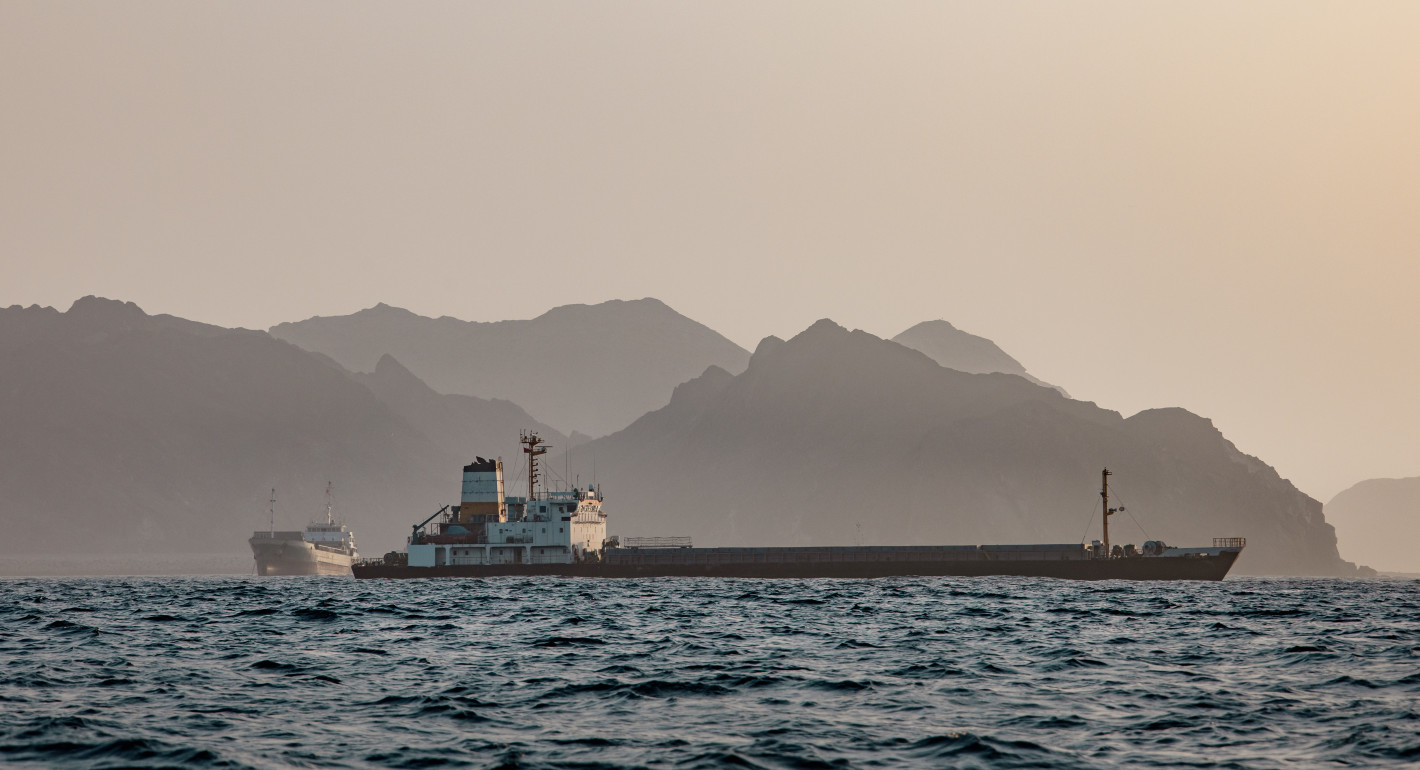
The United States and China are united by their primary interest in MENA: free trade. Geographically connecting several continents, and home to several of the world’s most important maritime chokepoints, MENA remains central to international trade. However, the string of simultaneous conflicts plaguing the region poses a significant risk to trade—a fact made especially tangible by the current war with Iran and its impact on shipping through the Strait of Hormuz. Thus, for both the United States and China, a stable, peace-driven order in the MENA region is key. Washington is also driven by interest in Israel’s security; Beijing is similarly driven by China’s need for MENA’s oil and liquid natural gas. Conveniently, these two interests are not only compatible, but both underline the need for peace and stability in the region.
The United States and China are united by their primary interest in MENA: free trade.
In some areas, China is catching up to, and even sometimes outpacing, the United States in MENA. Washington maintains a significant lead in military power, but China is poised to overtake the United States in economic power. The gap in diplomatic power is also narrowing, and China continues to build up its soft power reserves while the United States self-sabotages its own stock by systematically resorting to military means and deprioritizing diplomatic tools in implementing its policies in the Middle East.
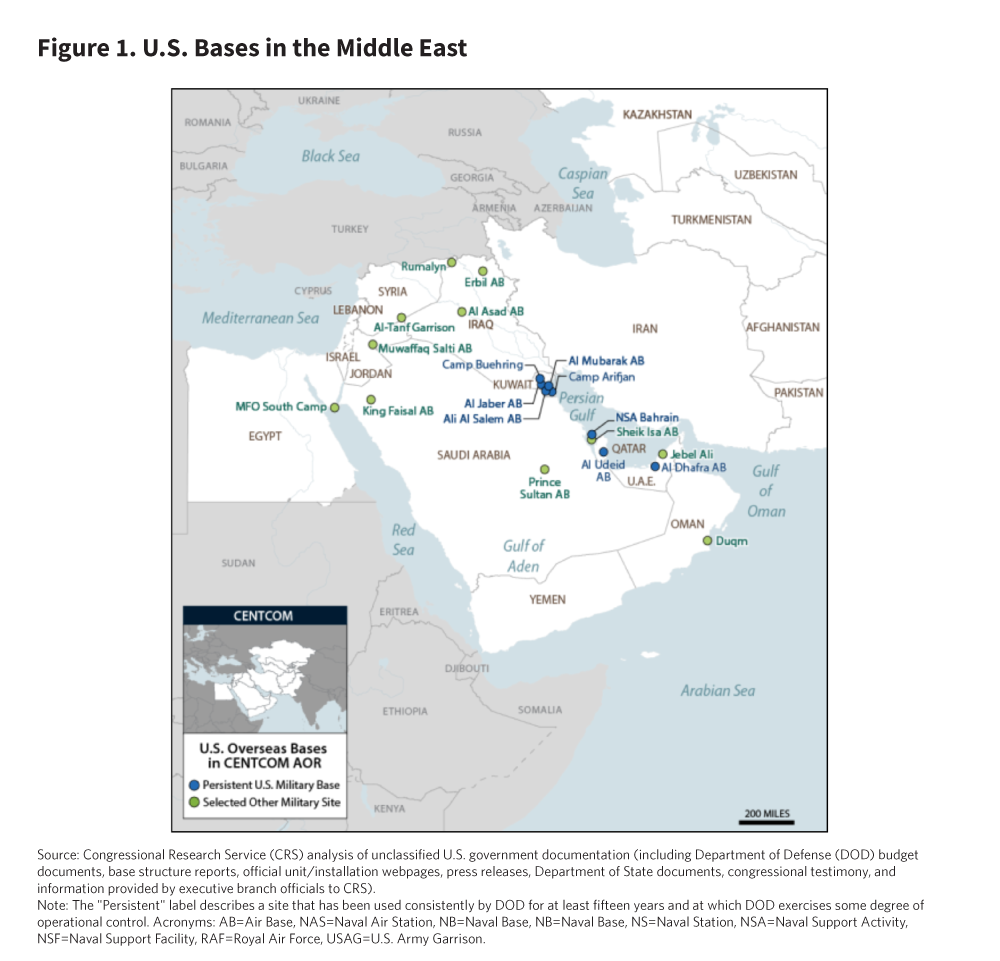
Militarily, the United States faces no meaningful competition from China in MENA. The United States has dramatically reduced personnel stationed in the region throughout the last several decades, but China has not stepped in. In fact, the only noteworthy presence of Chinese forces is their personnel contribution to UN peacekeeping, which is consistently at least double that of the United States in MENA. Compared to a vast network of U.S. bases (see figure 1), China maintains no bases in MENA, though it has one in Djibouti, from which it runs an anti-piracy mission in the Gulf of Aden. The United States has an extensive network of security and defense agreements across the region, including:
China, on the other hand, has avoided formal defense commitments, opting instead for strategic partnerships that offer limited security cooperation—including arms sales, joint training and exercises, joint research and weapons development, and intelligence sharing. China’s formal partnerships in the region are as follows:
The United States’ arms transfers to MENA, far outpacing China’s, remain a key strength of its military engagement with the region. According to the Stockholm International Peace Research Institute, in 2025, the Middle East (not including North Africa) accounted for about 21 percent of global arms imports. Across all of MENA, the United States’ share of arms imports was 64.3 percent in 2025; China had no recorded deliveries that year (see figure 2). From 2021 to 2025, China’s average share of arms imports was just 1.3 percent—peaking in 2023 at 2.3 percent. Until the war with Ukraine limited its export capacity, Russia, not China, supplied the markets Washington didn’t engage. Now, the only true competition the United States faces in this arena is from Europe, especially Italy and France.
China’s position of military inferiority is not necessarily a weakness—Beijing benefits greatly from the U.S. security regime in MENA. By not participating in war, and instead adopting anti-war politics, China has gained public favor, remained open to all states in the region, and limited any stains on its legitimacy record. Meanwhile, Washington’s military policies have soiled its record in the region in recent years.
Although China has benefited reputationally from its lack of military presence, it has also faced serious limits to its ability to respond to crises. In 2011, China had to undergo a massive effort to evacuate its nationals from Libya; in late 2023, when Houthi forces from Yemen targeted shipping lanes, China was absent from the twenty-member naval coalition formed to end the blockade; and as of spring 2026, it would be costly and logistically complex for Beijing to transfer assets to the region to open the Strait of Hormuz. Now, despite approximately 50 percent of the country’s crude oil imports transiting Hormuz, China has kept away from attempts to reopen the strait. Whether solely a strategic choice or also a consequence of maintaining a light military footprint, China’s military is largely uninvolved in MENA, even when it might be to Beijing’s benefit to lend a hand.
China’s position of military inferiority is not necessarily a weakness—Beijing benefits greatly from the U.S. security regime in MENA.
For both the United States and China, MENA’s most important role is an economic one. MENA is geostrategically significant because of the disproportionate share of global energy and trade flows funneled through its various chokepoints. Washington and Beijing have structured their economic engagement with the region accordingly.
The most critical risk to both Chinese and U.S. trade in recent years is conflict. However, the impacts of conflict on the economic standing of each of the two countries is telling. During the Red Sea crisis, Suez Canal traffic declined by 90 percent in 2024, with disrupted shipping causing an 80 percent increase in freight rates between Shanghai and Rotterdam between 2023 and 2025. Yet Chinese ships remained relatively unaffected thanks to China’s diplomatic relations with Houthi leaders. When Iran took control of the Strait of Hormuz in June 2026, Chinese ships once again received preferential treatment. However, the strait’s closure still impacts China; supply chain disruptions continue to hit domestic markets, and rising prices drive down import demand in MENA. Beijing would be better off with a stable, free flow of goods through the strait. While their specific needs differ, both states would benefit from security in the region.
In recent years, the regional focus of both Chinese and American economic activity has been the Gulf Cooperation Council (GCC) states, but Chinese trade in the Gulf far outpaces that from the United States. In 2024, China reported a $288 billion total trade value with the Gulf states—more than three times the GCC–U.S. figure of $86 billion. This differential reflects that China dominates trade in the region, earning the title of top import partner for the majority of MENA states.
The biggest strength of China’s economic model is infrastructure. MENA was “the top recipient of [China’s Belt and Road Initiative] investments in 2024, with deals valued at $39 billion—a 102 percent year-on-year surge.” Chinese projects in the region span port, rail, and telecom modernization and major transport infrastructure. The United States, by contrast, has had very limited and often ad hoc investment with one emerging exception: artificial intelligence (AI). In the Gulf, U.S. investments in AI infrastructure—data centers and semiconductor partnerships—are underway, especially in Saudi Arabia, Qatar, and the UAE.
In development assistance, U.S. retreat has been unambiguous and self-inflicted, whereas China’s activities have been consistent and strategic. In 2024, the United States obligated $12 billion to roughly 1,000 activities across sixteen MENA countries, and USAID’s MENA funds were set at $4.2 billion in 2024, up from $3.7 billion in 2023, with approximately $2 billion in humanitarian assistance targeted primarily at Gaza, Iraq, Syria, and Yemen. U.S. President Donald Trump’s dismantling of USAID in early 2025 eliminated 83 percent of the agency’s contracts and gutted $60 billion in aid around the world. This had a huge impact on MENA, where there is a deep dependence on aid. Experts have warned that the abrupt termination creates a gap that will not be filled easily and could further destabilize an already volatile region. Other analysts warn that partners will adjust, looking beyond U.S. aid toward stronger economic partnerships with China and the Gulf states—though they might not find the latter as willing donors as they once were.
Both China and the United States maintain strong diplomatic relations in the MENA region. While the two have historically approached relations quite differently, the Trump administration has broken from traditional diplomatic engagement on political issues like human rights and democracy, instead acting largely without consideration for the ethics of a state’s policies. Trump’s approach mirrors China’s method of engagement and has served to strengthen the U.S. position with many Gulf states—which, under former president Joe Biden, had shaky relations with the United States—but has proven largely unsuccessful in actually accomplishing diplomatic objectives.
China’s strongest asset is its lack of adversaries. In contrast to the United States—currently facing off against Iran and its regional network of non-state allies—Beijing has friendly relations with every state, including Washington’s strongest ally, Israel. China has full diplomatic relations across the region, giving it an advantage over the United States, which lacks relations with Iran, is still rebuilding with the new government in Syria, and has suspended embassy operations with Libya and Yemen for security reasons.
However, Washington has a much deeper and more diverse portfolio of treaties in the region. In 2025, the United States had more than 600 treaties in force with MENA states, spanning agriculture, cultural exchange, defense, education, environment, economics, and transportation. While there is no comparable quantitative data on China’s regional treaties, they rarely break from economic topics such as bilateral investment and double-taxation agreements. One notable exception is judicial assistance treaties, of which China has nine in MENA (with Algeria, Egypt, Iran, Kuwait, Morocco, Saudi Arabia, Tunisia, Türkiye, and the UAE).
Beijing has friendly relations with every state, including Washington’s strongest ally, Israel. However, Washington has a much deeper and more diverse portfolio of treaties in the region.
On conflict mediation, the United States has held a much more significant role than China over the past several decades. However, this role has declined—Washington has seen little sustained diplomatic success since its prime in the 1990s. This is largely due to a retreat from the multilateral institutions that defined U.S. diplomacy and gave it much of its legitimacy. China’s engagement has been and remains different. Rather than leading the charge, China has traditionally taken a more defensive stance, often dissenting from U.S. positions. For instance, in 2014, China used its United Nations Security Council veto alongside Russia to block a resolution referring Syria to the International Criminal Court. Still, meaningful examples of Chinese mediation—between Iran and Saudi Arabia, between various factions of Palestinians, and between Israel and Iran in 2025—exemplify Beijing’s less flashy approach.
A key aspect of China’s diplomacy in the region is public diplomacy, a form of soft power projection. While the United States has typically built its soft power around enforcing what it sees as global values, China has built its image on reliable economic partnerships with few strings attached. China is an especially appealing alternative when governments’ violations of human rights or actions toward other states disqualify them from U.S. support. In situations such as Egypt’s post–Arab Spring pivot or the United Arab Emirates’ F-35 hedging, when costs of Washington’s partnership—including political conditions—are high, partners can turn to Beijing. China’s noninterference policy is clear: In pursuit of peace, China’s diplomacy is centered around the people, not proxies, exclusive blocs, or geopolitical vacuums. The United States remains far more popular a prospective emigration destination than China, with 9.5 percent of Arab Barometer’s respondents desiring to emigrate there compared to just .4 percent to China; only France (9.9 percent) and Canada (11.2 percent) outpaced the United States. American culture is more appealing to MENA publics than China’s, perhaps as a result of a long history of propagating media, hosting educational exchanges, and building cultural centers. However, technology—a much more lucrative and influential field—is much more contested. From e-commerce to AI, MENA is increasingly turning to Chinese technology.
After October 7, 2023, the Arab publics’ opinion of the United States changed dramatically. According to Arab Barometer,
Prior to that day, U.S. favorability in Tunisia stood at 40%; by October 27, it plummeted to just 10%. At the time, Tunisian views of China were relatively static. Surveys conducted in the months that followed confirmed this drop in favorable opinion of the U.S., where in Jordan, Mauritania, Lebanon and Iraq favorability fell between 23 and 7 points compared with surveys completed before October 7. Meanwhile, China’s favorability increased in all those countries, with the exception of Mauritania, rising between 6 and 16 points.
In the most recent wave of Arab Barometer data, just 32.8 percent of participants viewed the United States favorably, compared to 67.2 percent who viewed it unfavorably; 64.3 percent held favorable views of China, compared to 35.8 percent unfavorable.
Despite the United States’s greater involvement in mediation and stronger institutional presence in MENA, recent years show that self-sabotage—in the form of the Muslim travel ban, visa restrictions, abetting the atrocities in Gaza, and now a war in Iran—has handed a diplomatic victory over to China on a silver platter.
The competition between the United States and China provides many MENA states the opportunity to hedge—though the forums and strategies each state uses vary. The only state that is truly unable to hedge is Iran, because of its designation as a U.S. adversary. Even Israel, with its special relationship with the United States, hedges in less sensitive non-security arenas, engaging the Chinese especially on technology and infrastructure projects. The current division of labor between the United States and China leaves room for regional middle powers to negotiate on military deals, trade agreements, technology imports, and their roles in diplomatic initiatives.
Historically, MENA countries are experienced in hedging between great powers. Egypt, Algeria, Iraq, and Syria hedged between the United States and the former Soviet Union for most of the 1960s to secure economic cooperation with Washington and get military aid and diplomatic support from Moscow. In the 1980s and 1990s, MENA hedged economically between the United States and the advanced industrial countries in Europe. Following the 2011 popular uprising in the Arab world and against the background of growing frustration with U.S. policies in various MENA countries, several governments in the region resorted to hedging once again between China, Europe, and the United States in military, security, economic, and diplomatic matters.
The current division of labor between the United States and China leaves room for regional middle powers to negotiate.
Today, militarily, the primary arena for hedging is in specific arms deals. While the United States provides the majority of arms to the region, there have been several occasions in recent years in which regional partners have turned to China for arms the United States has refused or been hesitant to hand over. For instance, the United States does not export some longer-range ballistic missiles and, in fact, restricts such transfers in support of the Missile Technology Control Regime—a constraint by which China is not bound. As such, China has supplied ballistic missile technology to Saudi Arabia for decades and even reportedly assisted Saudi efforts to develop its domestic production. Similarly, U.S. refusal to provide Egypt with F-35 aircraft drove Cairo to Beijing, with reported interest in the Chinese J-10C. When Washington’s export rules on unmanned aerial vehicles blocked Middle Eastern ambitions, states again looked to China for their armed drone sales. China filled the gap by exporting CH-4 and Wing Loong armed drones to Egypt, Iraq, Jordan, Saudi Arabia, and the UAE. The United States has since loosened its UAV restrictions, evidencing the power of MENA hedging.
Technology is another emerging arena for MENA actors to hedge, especially the Gulf states on AI-related issues. Gulf actors—especially Saudi Arabia and the UAE—collaborate with the United States but hedge by pursuing Chinese tech when U.S. restrictions are too limiting. As a result, Washington has eased export restrictions on advanced chips. In turn, Gulf states have reduced reliance on Chinese technology providers such as Huawei in sensitive infrastructure. The United States currently dominates high-end AI systems, but China’s cheaper and rapidly scaled alternatives encourage Gulf hedging. Countries such as Saudi Arabia and the UAE, although increasingly pursuing sovereignty strategies, will continue to leverage U.S. and Chinese offerings.
Economically, the lack of free trade agreements between regional powers and China is deceiving—MENA states are still pursuing special trade arrangements with China in addition to existing agreements with the United States. According to the Green Finance and Development Center, every MENA country except Israel has engaged with China on the BRI; Algeria, Egypt, and Saudi Arabia enjoy comprehensive strategic partnerships with China; Iran’s twenty-five-year comprehensive cooperation agreement covers economic cooperation; although now stalled, Iraq and China negotiated a framework for oil-for-infrastructure cooperation; and Qatar enjoys a strategic partnership with China. The economic arena is perhaps the most fluid for hedging, as fewer restrictions apply and trade is generally viewed as a less crucial strategic positioning than, say, weapons sales. Thus, foreign direct investments, trade balances, and aid commitments ebb and flow, not necessarily representing hedging behavior so much as standard business practices. Still, the competition between the United States and China presents MENA with leverage within the business sphere by allowing regional partners a choice between many offers.
Most MENA states participate in multiple multilateral organizations associated with both the United States and China, allowing them access to the diplomatic ears of both poles.
The most telling arena for diplomatic hedging is participation in multilateral organizations. Most MENA states participate in multiple multilateral organizations associated with both the United States and China, allowing them access to the diplomatic ears of both poles, with Egypt, Saudi Arabia, and the UAE acting as the biggest hedgers. Designated as Major Non-NATO allies, Bahrain, Egypt, Kuwait, and Qatar also engage in dialogue partnerships with the Chinese Shanghai Cooperation Organization. Sixteen of the nineteen MENA states—excluding just Syria and Yemen, with Lebanon listed as prospective—are members of the China-led Asian Infrastructure Investment Bank in addition to having received significant funding over the years from U.S.-led organizations like the World Bank. Egypt, Iran, Saudi Arabia, and the UAE are full members of the China-led BRICS bloc; Algeria, Egypt, and the UAE are members of the China-led New Development Bank. Türkiye is the only regional NATO member. Nearly all MENA states participate in the China–Arab States Cooperation Forum, except for non-Arab states Israel, Iran, and Türkiye. Bahrain, Egypt, Israel, Jordan, Kuwait, Morocco, Qatar, Saudi Arabia, Türkiye, and the UAE have all signed on to Trump’s newest multilateral organization, the Board of Peace. Across these many layers of multilateral engagement, MENA states fall on both sides of the line, benefiting from both Chinese and American leadership in international affairs.
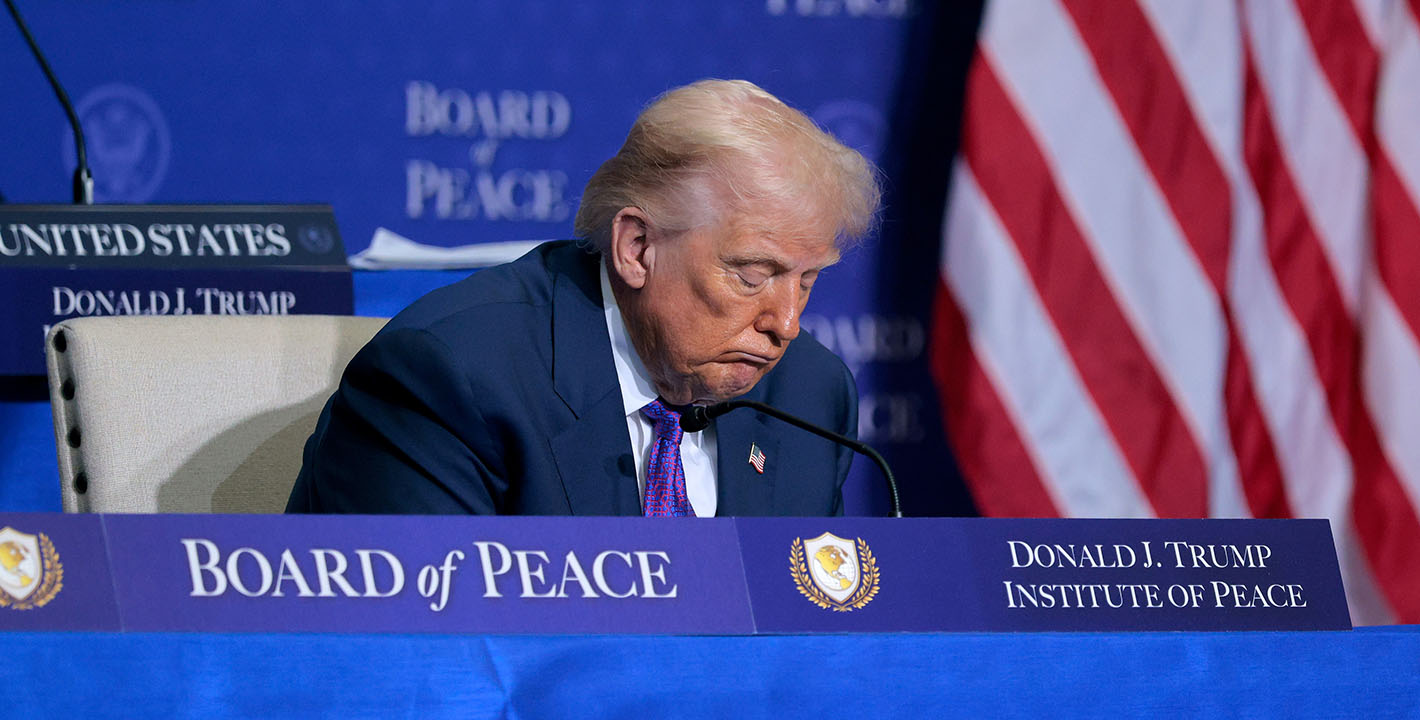
What is behind Marco Rubio’s announcement that the body is now an international nongovernmental organization?
Hedging in MENA is not limited to counterbalancing between the United States and China—in fact, third parties offer a safer alternative for those wishing to diversify away from the United States without sounding alarm bells. Saudi Arabia signed a strategic mutual defense agreement with Pakistan in 2025 that counts aggression against either country as aggression against both, and both Saudi Arabia and the UAE signed memoranda of understanding for defense cooperation with South Korea in February 2026, exemplifying a turn toward diversifying security partnerships. Building a web of security guarantors is an emerging strategy for the region, as the United States has proven unable to fully protect its allies’ security in the post–October 7 regional environment. While expanding military partnerships garner more attention, MENA actors also look beyond the United States and China for economic partnerships (such as the UAE and India’s free trade agreement or Egypt and Japan’s Suez Industrial Zone) and maintain strong diplomatic relationships beyond the so-called great powers.
Points of convergence between the United States and China in the Middle East and North Africa outweigh their points of contention. The two great powers also possess distinct strengths: U.S. superiority in military and security domains contrasts with China’s commercial and economic rise—accompanied by a more favorable public perception of China among the region’s populations. More than anything, however, China and the United States have different visions for their roles in the region: While Washington pursues hegemony at any cost, Beijing pursues strategic relations at the lowest cost possible.
Middle powers in the region are likely to continue hedging between Washington and Beijing to maximize their geostrategic gains. Any attempt to pressure these powers to choose an alliance with one of the two great powers would likely result only in strained relations with the great power exerting that pressure. It is, therefore, in the best interest of both the United States and China to gradually agree on a division of labor in the region that safeguards their respective interests in free trade, stability, and security.
Correction: This piece originally included more data about GCC trade volume with China and the United States over the years 2024 and 2025. As the data for 2025 has proven unreliable, the piece now focuses on 2024 data, and the accompanying graphic has been removed.

Director, Middle East Program
Amr Hamzawy is a senior fellow and the director of the Carnegie Middle East Program. His research and writings focus on Egypt’s and other middle powers’ involvement in regional security in the Middle East, particularly through collective diplomacy and multilateral conflict resolution
Former James C. Gaither Junior Fellow, Middle East Program
Kathryn Selfe was a James C. Gaither Junior Fellow in the Carnegie Middle East Program.
Carnegie does not take institutional positions on public policy issues; the views represented herein are those of the author(s) and do not necessarily reflect the views of Carnegie, its staff, or its trustees.
European allies are less focused on appeasing Trump and more focused on smoothing the transition to a Europe-led alliance.



Sophia Besch, Alper Coşkun, Nate Reynolds, …
Democratic erosion is undercutting four key elements of U.S. power, with mounting and likely lasting effects.

Thomas Carothers
For ninety years, Turkey has been positioned as the principal gatekeeper of Black Sea security. As a result, European and NATO efforts to support Ukraine will require closer engagement with Ankara.

Thomas de Waal
There is a disturbing structural parallel between the old global energy economy and the new green transition.

Angie Omar

Western Europe’s dual-use infrastructure melted down during its latest heat wave. If a predicted hot weather event can take the continent by surprise, what chance does it have to withstand unexpected geopolitical crises?

Rym Momtaz