

Commentary
Thomas de Waal
Source: Getty
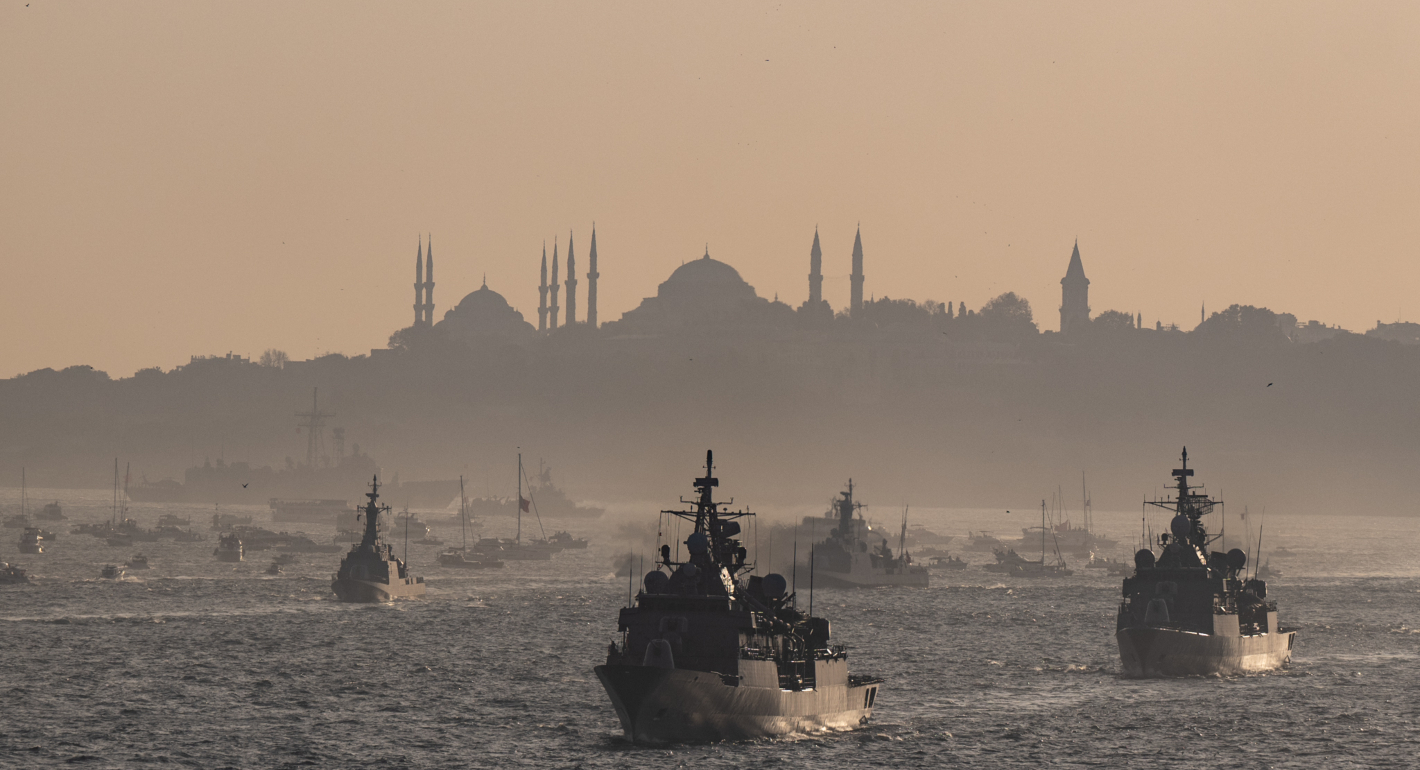
For ninety years, Turkey has been positioned as the principal gatekeeper of Black Sea security. As a result, European and NATO efforts to support Ukraine will require closer engagement with Ankara.
On February 28, 2022, four days after Russia’s full-scale invasion of Ukraine, Turkey invoked the powers granted to it under the 1936 Montreux Convention and announced restrictions on vessels of war passing through the Turkish Straits.
Turkey’s application of the convention, which will be ninety years old on July 20, 2026, gave Ankara authority over the passage of ships through the two straits that lead to and from the Black Sea. This move tilted the military balance of power in the early stages of the Russia-Ukraine conflict. The restrictions, together with verbal agreements Turkey struck with Russia and NATO countries, helped Ukraine to survive initial Russian naval onslaughts on Odesa and other ports and then gain the upper hand in maritime battles in the Black Sea. As more than 90 percent of Ukraine’s agricultural exports went through the sea’s ports before the war, Ukraine’s ability to keep the three ports in the Odesa region open is vital for the country’s survival.
The Montreux Convention remains the key international document on Black Sea security. Since 2022, Turkey has used the convention not only to assist Ukraine but also to pursue managed cooperation with Russia, as communicated in a series of interviews conducted by the author in Turkey in late 2025 and early 2026. As Turkey jealously guards its role as the gatekeeper of the Black Sea, Kyiv’s European and NATO partners have no option but to work within the security parameters set by the convention and engage closely with Ankara.
Turkey’s 2022 decision on the straits reflected its broader strategic agenda to retain a pivotal role in all Black Sea security and trade issues. This strategy, enabled by the authority granted to Turkey by the Montreux Convention, rests on three principles.
Turkey’s first overarching principle is what it calls “regional ownership” in the Black Sea, together with the sea’s other five littoral countries, including Russia. That means that Turkey discourages a broader NATO naval presence in the Black Sea and insists it will take the lead in the area, together with Bulgaria and Romania.
In announcing the formation in April 2026 of an Istanbul-based Maritime Component Command to keep a future peace in the Black Sea and a Black Sea Task Force to support Ukraine, Turkish officials were at pains to point out that the three littoral countries would lead the two structures. According to a Turkish military spokesman, “fourteen countries have declared their contribution to the Maritime Component Command; however, contributions to naval platforms will only be provided by the littoral countries: Turkey, Romania, and Bulgaria.”
A second principle, de-escalation of conflict in the sea, has both helped and hindered Ukraine. This principle was the basis of two verbal agreements made in February 2022 with Russia and non–Black Sea NATO countries, characterized as “Montreux Plus” by one Turkish official in November 2025 interview with the author. These deals halted the return of warships from Russia’s Black Sea Fleet to their bases, on the one hand, in exchange for nonlittoral NATO countries agreeing not to pass through the Turkish Straits, on the other. “We called on everyone to avoid further militarization of the Black Sea maritime zone,” said the official. Since then, Ankara has sought several times to negotiate a Russia-Ukraine ceasefire in the Black Sea.
A third principle is freedom of navigation for all civilian shipping, including Russia’s, through the Turkish Straits. The straits form one of the world’s critical maritime choke points, along with the Suez Canal, the Malacca Strait, and the Strait of Hormuz: narrow stretches of water whose blockage or closure can severely disrupt global trade. Turkey claims to be a reliable custodian of an open international waterway that carries agricultural goods and oil—in contrast to Iran’s behavior as a disrupter of global trade through the Strait of Hormuz.
The current policy regime in the Turkish Straits will persist as long as the war in Ukraine lasts. With Turkey having put restrictions in place because it characterized the Russia-Ukraine conflict in February 2022 as a war, the Turkish official said that a ceasefire alone will not change Ankara’s stance. The Turkish position is that only a durable truce or an actual settlement would qualify as peace and persuade Ankara that the restrictions can be lifted.
“To at least half of Europe there is no single international problem of greater importance than the control of the few short miles of waterway that connects the Black Sea with the Mediterranean, those narrow Straits which separate Europe from Asia,” wrote the scholars James T. Shotwell and Francis Deák in a book published in 1940.
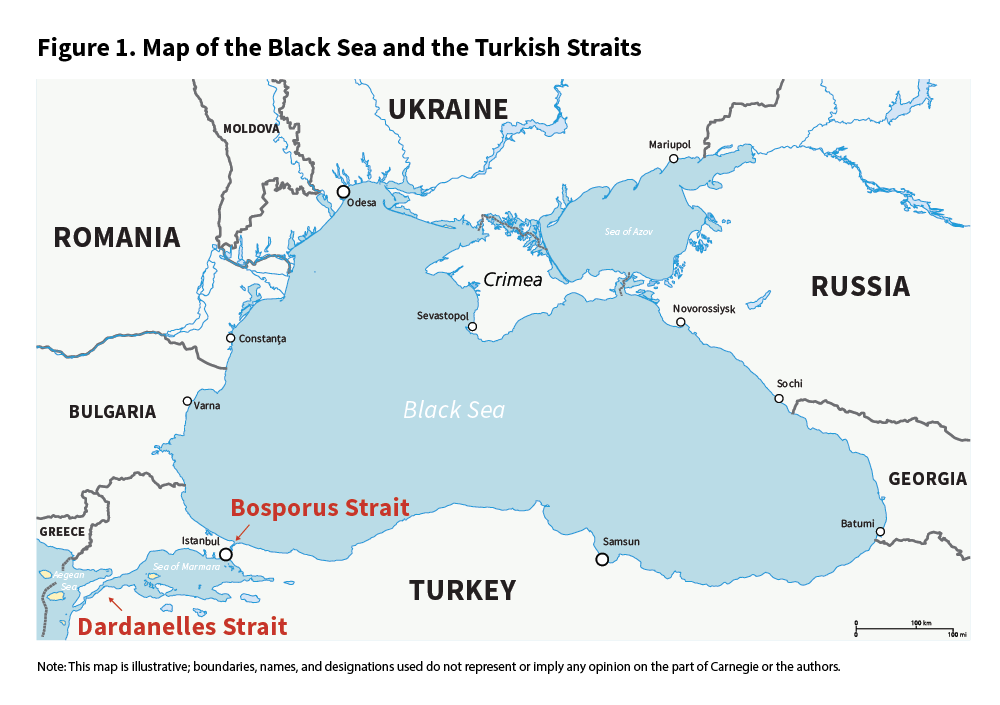
The signing of the Montreux Convention four years earlier resolved definitively this age-old problem in a way that was highly favorable for Turkey. The two straits that connect the Aegean Sea and the Black Sea are the 68-kilometer-long (42-mile-long) Çanakkale, or Dardanelles Strait, and the 30-kilometer-long (19-mile-long) Bosporus Strait, which passes through Istanbul. In the middle of the two straits lies the Sea of Marmara (see figure 1).
Control of these two waterways—and, therefore, of access to and from the Black Sea—has been a geopolitical prize for thousands of years. In the eighteenth century, Russian rulers harbored the ambition to control the straits at the expense of the Ottoman Empire, as they expanded their own empire to the south and sought unhindered access to the Mediterranean. The priority of Western powers was generally to keep the two straits as open as possible while not allowing either Russia or the Ottoman Empire to become too dominant.
In 1923, the straits were put under the supervision of an international commission as a consequence of the Treaty of Lausanne. Subsequently, the leaders of the new Turkish Republic sought to take back control of these crucial waterways.
A conference was convened in 1936 in the town of Montreux, Switzerland, to reach a new arrangement. The geopolitical timing was favorable for the Turkish authorities, as the key powers with an interest in the issue—Britain and the Soviet Union—both sought better relations with Turkey. On July 20, after four weeks of negotiations, ten states formally signed the Montreux Convention, which codified new provisions. Turkey was allowed to remilitarize the straits. Littoral states were granted greater privileges than nonlittoral countries, which were restricted in the tonnage limits of their warships in the Black Sea and the amount of time they could spend there. The wording of some of the convention’s articles gave Turkey discretionary powers. For example, Article 21 allows the Turkish authorities to close the straits “should Turkey consider herself to be threatened with imminent danger of war.”
Since 1936, defending the hard-won right to govern passage through these international waterways has been a pillar of Turkish foreign policy. Turkey’s foreign ministry calls the Montreux Convention “the essential element in the context of Black Sea security and stability.”
Over the past nine decades, the convention has proved extremely durable. Its text declared that it could be renegotiated after twenty years, but that did not happen. Article 28 states that one of the signatories can denounce the convention, in which case it lapses two years later and a new conference is convened. Article 29 says that every five years after the convention comes into force, it is possible to propose amendments, which need the support of other signatories to be successful. In practice, neither of these articles has been invoked.
The convention survived a major challenge at the end of World War II, when the Soviet leader, Joseph Stalin, complained to his British and U.S. allies that the convention created “a situation in which Turkey had a hand on Russia’s throat” and demanded that it be scrapped. Stalin’s Western allies said they were sympathetic. However, discussions of how specifically to change the straits regime reached an impasse and the convention stayed in place.
Subsequently, Stalin’s claims against Turkey backfired and drove Ankara to join NATO in 1952. “Turkey’s entrance into NATO was fundamentally guided by Russia’s claims and designed to preserve the status quo and not change the Montreux regime,” said Turkish historian Onur İşçi in a January 2026 interview.
Still, much of the language and terminology of the Montreux Convention now looks archaic in light of changes in international law and shipping over the past ninety years. The text says that dispute resolution is to be handled by the League of Nations, which was disbanded in 1946. In effect, this means that the UN would be asked to perform the same function—but it is not clear which UN structure would be called on.
The UN Convention on the Law of the Sea (UNCLOS), adopted in 1982, established a more permissive international doctrine of “transit passage” for vessels through the world’s maritime straits. However, UNCLOS also upheld the continuation of “longstanding international conventions,” granting Turkey a carve-out that preserved the Montreux regime. The regime was maintained even though, paradoxically, Ankara had not signed UNCLOS. In practice, this means that Turkey has tighter oversight of the Turkish Straits than other comparable powers in maritime straits across the world.
From the 1950s onward, the main concerns in the Turkish Straits were environmental ones, as maritime traffic increased. The number of vessels that pass through the Bosporus has increased at least sixfold since 1936. That around five large oil tankers a day travel through a major city along a channel that is only 700 meters (766 yards) wide at its narrowest point causes special concern.
This issue led to the most substantial domestic Turkish challenge to the convention, when in 2011 Turkish President Recep Tayyip Erdoğan announced plans to construct a new Istanbul Canal west of the Bosporus—a project that would also allow Turkey to charge tolls on shipping. The project was fiercely contested by a group of 104 retired Turkish admirals, who published an open letter saying that the scheme would undermine the Montreux Convention.
Although the canal project remains an official Turkish policy, it has been suspended, more for economic than for political reasons. In 2025, Turkey’s transportation minister said that the project was on hold and was still a long-term commitment with an unspecified time frame.
With the end of the Cold War, the fragmentation of the Warsaw Pact, and then the breakup of the Soviet Union, the Black Sea became home for the first time to six sovereign littoral states and a highly contested security zone once again.
Two new geopolitical trends shaped wider regional politics. First, the EU and NATO expanded to the sea’s western shores by incorporating Bulgaria and Romania, while Georgia and Ukraine aspired to join both organizations. The Mihail Kogălniceanu Air Base on Romania’s Black Sea coast near the city of Constanța grew and is on course to become the largest NATO base in Europe.
Second, under Erdoğan, Turkey developed a more assertive and independent foreign policy, often showing more defiance toward Western countries and inviting more cooperation with Russia. An emblematic decision was Moscow’s 2017 sale of the S-400 missile system to Turkey.
Turkey first exercised its Montreux Convention powers in this new context during the 2008 Georgia-Russia War. Turkey stopped two U.S. Navy hospital ships from passing through the straits into the Black Sea, citing the limits on ship tonnage set down in Article 18 of the convention for “vessels of war.”
In 2022, a much greater conflict—and test of the convention—followed when Russia launched its full-scale invasion of Ukraine. On February 27, Turkey’s then–foreign minister Mevlüt Çavuşoğlu announced that the fighting in Ukraine amounted to “a full-fledged war.” The next day, he said that Turkey would not just use the powers given to it by the convention. Referring to the verbal agreements struck with Russia and NATO countries, Çavuşoğlu stated, “We have warned all governments, littoral and nonlittoral, not to send warships through the straits.”
Under Article 21 of the Montreux Convention, Russia had the right to return ships from its Black Sea Fleet to their home base in Novorossiysk. Turkish officials estimate that there were up to thirty such vessels outside the Black Sea that could have exercised this right. But Turkey explicitly refused a Russian request to send four warships into the Black Sea.
In the first phase of the war, Russia’s assent in keeping these ships away was a significant factor in enabling Ukraine to repel Russian attempts to capture or blockade its main port, Odesa. Subsequently, Ukraine, despite lacking a full naval fleet comparable with that of Russia or Turkey, used maritime drones to inflict devastating damage on Russia’s Black Sea Fleet, most notably sinking the fleet’s flagship, the Moskva, on April 14, 2022. Since then, Russia has been forced to redeploy its naval vessels away from Crimea.
Western officials acknowledged Turkey’s role in enabling these developments. Speaking in Ankara on February 20, 2023, then–U.S. secretary of state Anthony Blinken said, “[Turkey’s] continued implementation of the Montreux Convention deterred naval escalation in the Black Sea and helped protect Ukraine’s coastline.” Russia, however, tolerated this state of affairs for being, on balance, better than the alternative. Moscow’s evident calculation was that because of the other part of the Montreux Plus deal, Turkey also prevented an influx of NATO vessels, which could have assisted Ukraine.
The military setbacks Russia suffered in the Black Sea may also have persuaded it not to insist on its rights under Article 21. If Russian ships had been allowed back into the Black Sea, they might not have been let out again, making them targets for Ukrainian attack. Given this threat, the vessels might be more useful to Russia in the Mediterranean or the Baltic Sea.
This balancing act affirmed Ankara’s strategic posture of “Turkey first, NATO second” in the Black Sea. A 2023 speech by Admiral Ercüment Tatlıoğlu, commander of the Turkish Naval Forces, made this stance clear, as he referred to NATO in the Black Sea in the third person (“they”) rather than the second person (“we”). The commander said, “Our goal is for Montreux to be respected. . . . As Turkey, we provide security in the Black Sea. They should not turn the Black Sea into a Middle East. That is why we do not want any country or NATO to enter the Black Sea.”
Turkey’s regionally focused policy extends to minesweeping operations. Since the start of the Russia-Ukraine war in 2022, several hundred sea mines have been laid in the Black Sea. Many of them have drifted, endangering ships crossing the area.
In 2023, Britain’s Royal Navy donated two decommissioned mine hunters to Ukraine for use in the Black Sea. However, in January 2024, Turkey refused these two vessels passage to the sea, citing the Montreux Convention’s Article 19 ban on belligerents’ warships using the straits. Since then, the two ships have been based in the UK city of Portsmouth awaiting a change in the situation. Two further mine hunters, donated by Belgium and the Netherlands, have also been deployed to Portsmouth.
The UK expressed disappointment that Turkey was impeding minesweeping efforts by forbidding the ships from traveling to Ukraine. Ankara responded that it was taking the lead in demining the Black Sea through the Mine Countermeasures Task Group it had established with Bulgaria and Romania.
When visiting Russian President Vladimir Putin in Russia’s Black Sea resort of Sochi in September 2023, Erdoğan referred to “our Black Sea.” Turkey and Russia, the two most powerful countries in the area, have a long and difficult historic relationship, which Seçkin Köstem of Bilkent University has called “managed rivalry.” Long-standing contestation in the two states’ shared neighborhood is combined with a common agenda of minimal Western interference and mutually beneficial economic cooperation.
İşçi said that there are two main aspects to the current Ankara-Moscow relationship: “One is purely strategic. Turkey views the Black Sea as a sort of historically Russian-Turkish zone of cooperation and doesn’t want to upset that. The other one is economic: Turkey is benefiting from Russian trade even more so during the war—although possibly that has peaked now.”
The economic and energy relationship between Russia and Turkey was already strong before 2022. The war and Western sanctions against Russia have boosted economic ties further. Turkey’s trade with Russia has boomed. Turkish Airlines is the biggest international flight carrier operating in Russia.
Consequently, in the current war, said Mustafa Aydin of Kadir Has University in May 2026, Turkey is “pro-Ukraine but not anti-Russia”—a difficult policy to pursue in practice. Having acted as mediator for the only direct negotiations between the two sides in early 2022, Ankara still aspires to be a peacemaker between Russia and Ukraine.
In July 2022, Turkey, along with the UN, co-sponsored the Black Sea Grain Initiative, which enabled exports of Ukrainian grain in return for an easing of restrictions on Russia’s agricultural exports. The deal was driven by the need to keep alive Ukraine’s economic lifeline through the Black Sea and by fears about global food security caused by the war. Before the conflict, the World Bank estimated in 2019 that Ukraine accounted for over half of global sunflower oil production, while Russia and Ukraine together made up 25 percent of global exports of wheat and 14 percent of the world’s corn exports.
Today, Moscow does everything it can to blunt Turkey’s support for Ukraine. Since 2022, Russian officials have hinted that although they abide by the verbal agreement their government made with Turkey, they are watching closely to see that Ankara sticks to the other half of the deal, which keeps its nonlittoral NATO allies out of the Black Sea.
In a joint article in 2023, five Russian authors said, “For now Russia has taken a wait-and-see position and refrains from any declarations about applying Article 19 of the convention. However, if pressure is exerted on Turkey by its NATO allies, this decision could be reviewed, as it was made purely for declaratory and image purposes.”
In November 2024, Nikolai Patrushev, a close ally of Putin and a former head of Russia’s Security Council, said in a newspaper interview, “Westerners should firmly understand that Russia is strongly established in the Black Sea, and we won’t allow our positions to be weakened in this region. What’s more, we won’t tolerate the permanent naval military presence of non–Black Sea states in contravention of the Montreux Convention.”
Russia highlighted the agreement again in April 2026 when, amid reports of Turkey’s new Maritime Component Command, the Russian embassy in Ankara posted an image on social media that depicted a 1936 newspaper headline about the convention, warning that it must be observed.
For its part, Ukraine is often frustrated that Turkey, while calling for de-escalation in the sea, is not doing enough to condemn Russia’s continued attacks on Ukraine’s infrastructure and shipping.
Since the Black Sea Grain Initiative ended in July 2023, Turkey, along with Romania and Bulgaria, has helped ensure that Ukrainian ships can still travel by keeping close to the sea’s western coast. However, since spring 2025, Russian attacks on Ukrainian port infrastructure in the three ports in the Odesa region have intensified, hurting both Ukraine’s export and import capacity. Ukrainian Navy Spokesman Dmytro Ryzhenko said in April 2025, “It needs to be possible to go directly from Odesa to the Bosphorus across the middle of the Black Sea and not [hide] in the territorial waters of neighboring countries.”
The Ukrainian authorities have also expressed frustration at Turkey’s tolerance of Russian so-called shadow fleet vessels transiting the Turkish Straits in plain sight. Some ships carry grain seized from occupied parts of Ukraine, while others export oil to Turkish refineries. In practice, Kyiv says, Turkey affords the same rights to legitimate Ukrainian ships, which face Russian attacks or mines, as it does to Russian shadow fleet vessels.
There were also reports for a time that Russia was using civilian auxiliary vessels to carry weapons in and out of the Black Sea in violation of the Montreux Convention. “There was open violation by roll-on-roll-off civilian auxiliary vessels. We can assume that Turkey had intelligence on this and preferred to ignore suspicious activities. But it has stopped—we haven’t seen this for one year now,” said Yörük Işık, a ship-tracking expert and head of the consulting firm Bosphorus Observer, in a May 2026 interview.
For Turkey, the Montreux Convention remains an essential framework that allows Ankara to be the indispensable actor in Black Sea security and trade issues while coordinating with the other littoral countries.
Although it wants to see an end to the war in Ukraine, Turkey is in no hurry to lift the restrictions it imposed in 2022. Turkish officials are clear that a ceasefire is not enough for that to happen and that a more durable peace needs to be in place. But it is still important to be ready for what comes after the end of the wartime Montreux regime in the Black Sea.
Supporters of Ukraine express frustration that Turkey is not doing more to protect Ukrainian shipping and infrastructure in the Black Sea. Some U.S.-based think tanks have called for a more robust U.S. role in the sea’s security issues, regretting, for example, that Ankara’s actions “hinder the ability of NATO allies as non-belligerents to sail warships into the Black Sea.”
For a variety of reasons, which range from strategic balancing to economic self-interest, the Turkish authorities tread a cautious line with Russia, however, and are careful not to take any step that Russia could claim violates the Montreux Convention. As a result, Turkey will seek to manage Russia, rather than openly confront it.
Given these constraints, Ukraine’s Western partners have no alternative but to engage closely with Turkey on Black Sea issues. With no option of acting without Turkey, they must look for ways to assist Ukraine in the sea that align with broader Turkish interests.
One issue on which Ankara may be persuaded to be more proactive is oil carriers. Around one-fifth of the five to fifteen oil carriers that transit the straits every day (depending on the season) is a Russian shadow fleet vessel, in Işık’s estimation. Many of these vessels are old and unseaworthy, and it is in Turkey’s environmental interest that they be subject to inspection. Turkey has discretionary powers to do more here. For example, Article 3 of the Montreux Convention allows Turkey to inspect vessels for sanitary checks and could potentially be applied to vessels that look especially dangerous.
A second way in which Western powers can both help Ukraine and honor the letter and spirit of the convention is by boosting the naval capacity of the two EU and NATO littoral states, Bulgaria and Romania. Romania’s navy is still roughly only one-sixth the size of Turkey’s, while Bulgaria’s is even smaller. However, Romania is building and acquiring more ships, including from Turkey, and both countries already cooperate with Turkey in demining activities and will benefit from more training and resources to tackle the threat of mines. The EU’s plan for a maritime hub in Constanța is another example of a capacity-building project that fits within the doctrine of regional ownership.
Looking forward, a third priority is to support and encourage Turkey’s ambition—which is already taking shape—to play the leading role in the maritime part of the coalition force intended to support Ukraine in the event of a ceasefire. Turkish officials say this force will use Turkey’s guardian role bestowed on it by the Montreux Convention to lead patrols, conduct air surveillance, and enforce a ceasefire in the Black Sea. Turkey’s partners can again support Bulgaria and Romania in this effort and plan proactively on how this force can protect Ukraine’s shipping and port infrastructure.
The Montreux Convention, for all its archaic features, is here to stay. Measures such as these fall within the logic of the convention and could help Ukraine to keep its vital maritime lifeline open while aligning with Turkey’s ambition to remain the main arbiter of Black Sea security.

Senior Fellow, Carnegie Europe
Thomas de Waal is a senior fellow at Carnegie Europe, specializing in Eastern Europe and the Caucasus.
Recent Work
Thomas de Waal

Thomas de Waal, Areg Kochinyan, Zaur Shiriyev
Carnegie does not take institutional positions on public policy issues; the views represented herein are those of the author(s) and do not necessarily reflect the views of Carnegie, its staff, or its trustees.
Debate is heating up on how Turkey could be integrated into a common European defense framework. Commercial and industrial deals offer a better chance at alignment than sweeping political efforts.

Marc Pierini
Following Ursula von der Leyen’s gaffe equating Turkey to Russia and China, relations with Ankara risk deteriorating even further. Without better, more consistent diplomatic messaging, how can the EU pretend to be a geopolitical power?

Sinan Ülgen
The U.S.-sponsored TRIPP deal is driving the Armenia-Azerbaijan peace process forward. But foreign and domestic hurdles remain before connectivity and economic interdependence can open up the South Caucasus.
Thomas de Waal, Areg Kochinyan, Zaur Shiriyev
Over the past two decades, regional collaboration in the South Caucasus has intensified. Turkey and the EU should establish a cooperation framework to accelerate economic development and diversification.


Feride İnan, Güven Sak, Berat Yücel
Europe’s interests in Syria extend beyond migration management, yet the EU trails behind other players in the country’s post-Assad reconstruction. To boost its influence in Damascus, the union must upgrade its commitment to ensuring regional stability.

Bianka Speidl, Hanga Horváth-Sántha