

Commentary
Beijing regulated AI—and then Chinese AI companies took off.
Matt Sheehan
{
  "authors": [
    "Aaron David Miller",
    "David Rennie"
  ],
  "type": "questionAnswer",
  "blog": "Emissary",
  "centerAffiliationAll": "dc",
  "centers": [
    "Carnegie Endowment for International Peace"
  ],
  "englishNewsletterAll": "americanStatecraft",
  "nonEnglishNewsletterAll": "",
  "programAffiliation": "ASP",
  "programs": [
    "American Statecraft"
  ],
  "regions": [
    "China",
    "United States",
    "Iran"
  ],
  "topics": [
    "Technology",
    "Economy",
    "Trade",
    "Foreign Policy",
    "AI"
  ]
}
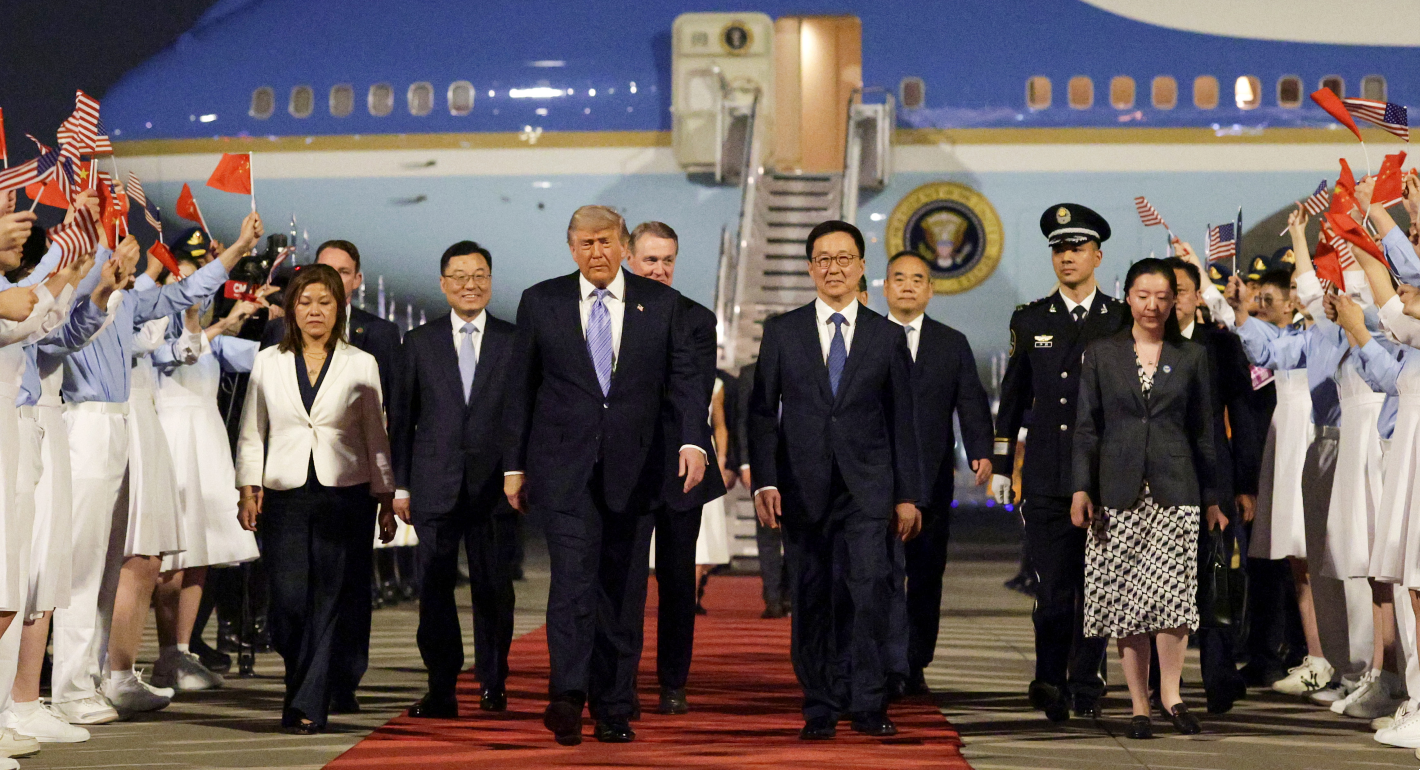
Trump arrives in Beijing on May 13, 2026. (Photo by Alex Wong/Getty Images)
Why the outcomes of the U.S.-China meetings may be limited.
On Tuesday’s episode of Carnegie Connects, Aaron David Miller talks to David Rennie, geopolitics editor at the Economist, about the upcoming summit between U.S. President Donald Trump and Chinese President Xi Jinping.
A portion of their conversation, which has been edited and condensed for clarity, is below.
Aaron David Miller: In terms of expectations and outcomes, where do you think we’re going?
David Rennie: Maybe I’m kind of [jaded] after ten years in China. I’m not as optimistic . . . even on something like AI.
[My skepticism] goes back to a conversation I had with a Chinese nuclear strategist, Zhao Tong. He said to me: China believes that winners write the rules. So in any technological contest, whether it’s AI or nuclear weapons or [rules for] satellite warfare, China’s view is as long as America is ahead, then even having that conversation is a trap. [It believes the conversation is] designed to keep [China] down, because the weak always come off worse from any negotiation, the strong write the rules, and rules aren’t intrinsically of any value—they are the weapons by which the strong impose their will.
So I think as long as China feels that in core AI technologies it’s behind, it is going to be exceptionally wary of even opening a discussion, that it will feel as a kind of concession to Trump.
China doesn’t do anything for free. So if you want to have any serious discussions on any topic in this summit, China will expect to be paid for those discussions with some other tradeoff.
Aaron David Miller: What do you think is the most that can be achieved of the main issues?
David Rennie: Taiwan is a really interesting one, because I think there is a real fear—in Taiwan, but also for friends of Taiwan—that Trump will sell Taiwan for soybeans.
I’ve spoken with people who used to work on China with Trump, and they said he knows how valuable Taiwan is to Xi, and his reputation as a brilliant dealmaker matters to him more than anything else. So he wouldn’t want to give Xi the gold prize without something absolutely colossal in return. And it’s hard to imagine what Xi would be willing to give him in return. There aren’t enough soybeans, effectively. [China likely] would like [Trump] to say stuff about arcane changes of language, which are designed to induce despair in Taiwan—opposing independence as opposed to supporting independence. Or arms sales: remember Ronald Reagan gave assurances to Taiwan that he would never discuss arms sales to Taiwan with the Communists in Beijing. Trump has already told us on Truth Social that he’s been talking about arms sales packages to Taiwan with Xi. So those are the kinds of things in the mix.
I suspect that with the presence of those CEOs, Trump [will] need to come away with some big wins—purchases of lots of American stuff. That’s not a guess—that’s talking to people in America who worked on the China dossier until very recently. That’s their views. I interviewed Jamieson Greer, the U.S. trade representative, for the Economist in January, and he basically admitted that they’re no longer trying to change China’s economic model. They just want to sell some stuff. So I think Trump could sell the summit as a win if it maintains the truce on mutually assured economic destruction and it sells a bunch of stuff. I think that could be where we end up.
Invalid video URL
Aaron David Miller: How important is Trump to Xi in the context of this summit? What does Xi want?
David Rennie: There are definitely things that China would like. They would like the most advanced semiconductors, for example—although there’s a debate about the extent to which they want to get dependent on those.
China has very large oil reserves, but a global recession triggered by a never-ending closure of the Strait of Hormuz is not great for China. Trade has gone down as a share of its GDP—it’s around 37 percent. But given that they’ve made a gigantic bet on advanced manufacturing and they don’t want to stimulate domestic demand, they have no choice but to seek their profit margins and their markets somewhere else. China currently runs at 30 percent of global manufacturing and is responsible for 13 percent of global demand consumption. According to the United Nations, they’re due to get to 45 percent by 2030. That is a gallon trying to fit in a pint pot. It has to go somewhere. As America is walling off, they needed to go elsewhere. They don’t want Trump to tank the economy.
So that then brings you to: What does China want Trump to do in Iran? What might Xi be willing to do to put pressure on Iran? And the evidence of the past—even thinking back to his unwillingness to put much pressure on Russia over Ukraine—is pretty limited, and there are a number of reasons for that.
I think one is distrust. The other is: Remember when Trump surprised everyone by using the phrase “G2” in one of his Truth Social posts last year about a meeting with Xi? When Chinese policy types talk to people like me, they say, “We don’t like the term G2. We’re very good friends with everyone in the Global South, and they really don’t like it when we talk about there being a G2.” The optics of China publicly pressuring Iran are just not how they roll. They detest sanctions in all contexts. They like deniable coercion. And the idea of ganging up with America against a country like Iran will not be done in public.
China is also an intensely cautious actor in somewhere like the Middle East. It’s all about buying stuff, selling stuff, investments, infrastructure. It’s not about taking big security risks. When I was there in March, Chinese public opinion—partly because of the highly censored news content they’re getting—was kind of like “plucky Iran being bombarded by the vicious, brutal American hegemon and its sinister Svengali-controlling Israel” (tremendous amount of antisemitism in that analysis as well).
The latest from Carnegie scholars on the world’s most pressing challenges, delivered to your inbox.
Aaron David Miller: And pursuing a 360-degree foreign policy means being friends with everyone.
But you draw a bright line at any serious effort for Xi to say to the Islamic Revolutionary Guard Corps: There will be consequences for you in our relationship, unless you find a way to begin to de-escalate this. That’s a bridge too far in your view?
David Rennie: He is willing to use coercion, right? We’ve seen him use coercion on all kinds of countries. Economic coercion is their thing, but they like it to be deniable. And to do it in coordination with the Americans would be, I think, difficult.
The other thing that’s important to remember is that China was the buyer of most Iranian oil—getting it at a big, fat discount. But if you look at the overall investment flows from China to Iran, they are absolutely dwarfed by China’s investment flows with the Gulf Arab states. They are far more excited about Saudi Arabia and the UAE in particular than they are with Iran, which is a useful source of cheap oil. But until this war broke out, the Iranians were pretty frustrated with how little they’d actually gotten out of the Chinese. And right now, if Iran is in a survival mode, the Strait of Hormuz is kind of a deterrent card against being attacked all over again by the Americans and the Israelis.
There’s a great writer, Jonathan Fulton, who has a China–Middle East newsletter I recommend. He had this nice phrase the other day about when you’re trying to fight to survive—I’m misquoting him, probably—you’re not particularly interested in buying a new metro line from China right now. China’s got stuff, but this is not the moment for a lot of the stuff that China offers.
Everyone is trading off. Everyone knows that dependency on China is a bad deal. But sometimes it’s not as bad a deal as the alternative. I was in India in March for the Raisina Dialogue. An adviser to [Indian Prime Minister Narendra] Modi said: Fifty-five percent of our oil and gas comes through the Strait of Hormuz. We are dying here. We need solar panels and renewable electricity that we can make here in India. Where are we going to get that? China. Is there a national security concern about buying all that green tech from China? Sure, there is, but the Strait of Hormuz is closed.
No one is dealing with good choices and bad choices. It’s a world of bad choices out there.
Watch the full conversation on YouTube, and subscribe to get more Carnegie Connects.

Senior Fellow, American Statecraft Program
Aaron David Miller is a senior fellow at the Carnegie Endowment for International Peace, focusing on U.S. foreign policy.

David Rennie
Geopolitics Editor and The Telegram Columnist, The Economist
David Rennie is geopolitics editor of The Economist and author of The Telegram column. He joined The Economist in 2007. From 2007-10 he was the EU correspondent and “Charlemagne” columnist, based in Brussels. From 2010-12 he was British political editor and “Bagehot” columnist, in London. In the summer of 2012 he moved to Washington DC. He was “Lexington” columnist 2012-17, and Washington bureau chief 2013-18. From 2018 to September 2024 he was Beijing bureau chief and “Chaguan” columnist. Previously, he was on the foreign staff of the Daily Telegraph, with postings in Sydney, Beijing, Washington DC and Brussels.
Carnegie does not take institutional positions on public policy issues; the views represented herein are those of the author(s) and do not necessarily reflect the views of Carnegie, its staff, or its trustees.
Beijing regulated AI—and then Chinese AI companies took off.

Matt Sheehan

But their "principal to principal" model will only be as effective as the political strength of each leader back home.

Damien Ma
Previous dialogues ended in failure. This time could be different.
Scott Singer
Five problems—and solutions—to make it actually work as a tool of great power competition.
Afreen Akhter

In the latest Five-Year Plan, the Chinese president cements the shift to an innovation-driven economy over a consumption-driven one.
Damien Ma