

Commentary
Natural disasters are no longer local incidents but sources of systemic risk that threaten vital infrastructure and the economy—and public support for international engagement.
Leonardo Martinez-Diaz
{
  "authors": [
    "Kate Gordon",
    "Noah Gordon"
  ],
  "type": "questionAnswer",
  "blog": "Emissary",
  "centerAffiliationAll": "dc",
  "centers": [
    "Carnegie Endowment for International Peace"
  ],
  "englishNewsletterAll": "ctw",
  "nonEnglishNewsletterAll": "",
  "programAffiliation": "CC",
  "programs": [
    "Carnegie California",
    "Sustainability, Climate, and Geopolitics"
  ],
  "regions": [
    "United States"
  ],
  "topics": [
    "Subnational Affairs",
    "AI",
    "Technology",
    "Energy",
    "Climate Change"
  ]
}
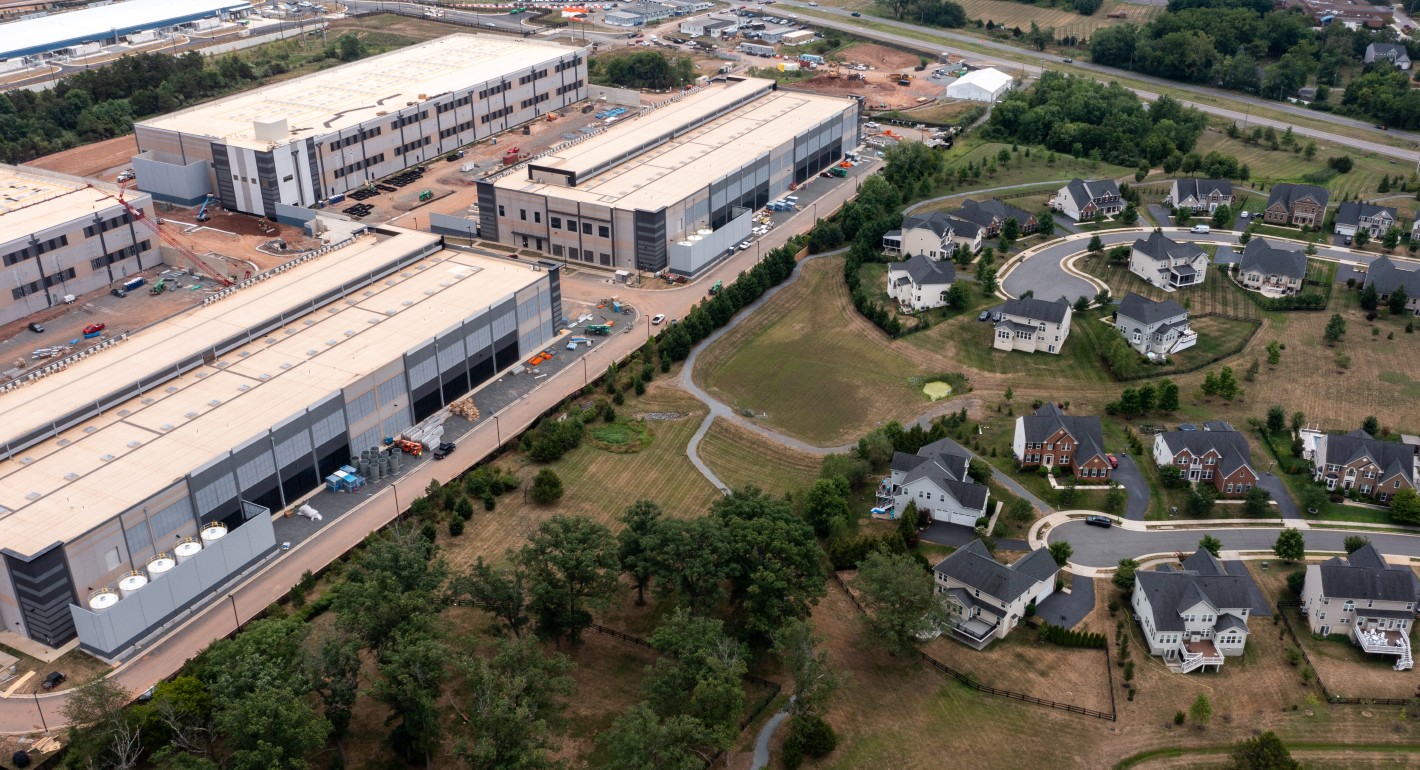
Data centers next to a neighborhood in Stone Ridge, Virginia, in 2024. (Photo by Nathan Howard/Getty Images)
Examples from Virginia and Lake Tahoe reveal complex situations that governments could use to fund critical grid upgrades.
In recent weeks, data centers have been branded as the villains in stories about electricity supply in Lake Tahoe and Virginia. What’s happening, and is this label deserved?
Noah Gordon: In Lake Tahoe, we have people living on the California side of the border who may have to find a new electricity supplier next year—the Nevada-based company that has been supplying them is shifting focus, seemingly to supply data centers. In Virginia, the state’s largest utility, Dominion Energy, is being bought by the giant energy company NextEra, whose shareholders seem to like the idea of supplying power to the state that includes Data Center Alley. I wouldn’t say data centers are clearly the villains in either story, but we’re seeing more and more complaints about the rush to build these things. Gallup says seven in ten Americans oppose constructing data centers in their areas. A Carnegie survey found that a plurality of Californians think AI data centers are mostly bad for the quality of life of people living nearby.
Kate Gordon: The decision by NV Energy to stop supplying the Lake Tahoe region’s main electricity provider, Liberty Utilities, comes on the heels of a decade of electricity cost increases and growing uncertainty in the region. Tahoe has faced a series of “public safety power shutoffs” that disable large sections of the grid at times of increased wildfire risk, leaving residents without power for hours at a time. Wildfire mitigation has also been increasing electricity bills in the region due to NV Energy’s vegetation management and higher insurance costs. Data centers are seen as just the newest threat to residents’ quality of life, so it’s no wonder they have become the villains of the moment.
How do data centers affect those living near them?
Noah Gordon: It’s a mixed picture.
Data centers do provide a lot of property tax revenue—nearly half of the tax revenue for the world’s largest data center hub in Loudoun County, Virginia. They can also provide temporary jobs for construction. On the other hand, they can be noisy. Jael Holzman of Heatmap News reports that noise is the “number one reason for opposition in cases where projects were ultimately canceled.”
As a climate researcher, I see pollution as the biggest concern, in terms of both greenhouse gas emissions and local air pollution. Power for data centers is driving a boom in U.S. natural gas consumption, and with gas turbines in short supply, some projects are using less efficient turbines that put lots of dangerous particulate matter in the air—see the xAI project in Memphis.
How can (and should) governments be acting in response to these issues?
Noah Gordon: I think we’re seeing some interesting initiatives to take advantage of the fact that the world’s richest and most powerful companies, from Meta to Microsoft, are dependent on an abundant supply of electricity. Will they be persuaded to spend more of their capital on building out a strong power grid, with more transmission so power can get where it needs to go and fewer shortages of key electrical components such as transformers?
Kate Gordon: The companies investing in data centers and increased electricity supply are in a moment of extreme urgency as part of the perceived AI race with China. That urgency puts them into a perfect position for the government to ask them to cover at least some of the costs of rising energy demand, such as infrastructure that is often left to governments (the taxpayers) or utilities (the customers) to fund. These include grid upgrades and resilience measures, or provision of new clean energy supplies that may long outlast the centers themselves.
Some state governments are already pushing to incorporate these costs into data center approvals, which makes good sense. In the Tahoe region, the Nevada and California governments should both be requiring the data center companies to invest in additional clean energy generation and distributed energy solutions such as microgrids, home batteries, and other “virtual power plant” approaches that have the added benefit of reducing wildfire risk.
Noah Gordon: Jane Flegal has an interesting idea: an American Grid Infrastructure Fund, which would have hyperscalers pay the full costs of the infrastructure their power loads require. This would go beyond the vague pledges the White House is backing.
What do you see as missing in the data center debate?
Noah Gordon: There is a lot of information out there about how data centers affect power prices. But it’s not clear-cut in either direction. In some cases, we do see data center load causing demand to outpace supply and thus raising power prices for everyone. For example, on PJM, the big mid-Atlantic grid, data centers are raising wholesale prices. However, when there is some spare capacity in the system, data centers can become new customers, spreading the fixed costs of the grid (for power lines, maintenance, etc.) across more consumers and helping keep prices down. In Virginia, power prices have been relatively flat in recent years. Data centers and increased demand are just one of many factors.
Kate Gordon: One thing that I don’t think is being talked about enough: what happens when the type of data center being built today inevitably becomes a stranded asset. Technological advances and land use constraints are already making the next generation of data centers smaller and more efficient. What happens to the current facilities when they are abandoned through bankruptcy or consolidation? Will they dot the landscape like empty shopping malls and big box stores and warehouses? Whose problem will it be to find ways to reuse them?
Given their unique design and massive power consolidation, data centers are even harder to repurpose than these other types of facilities, some of which are actually being turned into—you guessed it—data centers. These centers could be co-located with greenhouses or other users of their waste heat and energy, but that’s an idea communities may want to think about ahead of time, not after the fact.
Nuclear energy has been discussed as one solution to rising demand from data centers. Is this viable?
Noah Gordon: Nuclear is a sideshow for the next few years at least. Yes, some big tech firms have signed deals to restart nuclear plants that were closed or closing, which is great because nuclear is a low-carbon power source. But there are only a handful of those. Other companies are signing deals to use small modular reactors (SMRs) to power their data centers, but the United States has not yet turned on commercial SMRs.
In the medium term, I’m more excited about enhanced geothermal than nuclear when it comes to clean power sources. The leading U.S. firm, Fervo, just pulled off a major initial public offering.
Kate Gordon: Nuclear power from Diablo Canyon is already part of California’s clean energy supply, providing about 20 percent of the state’s zero-carbon power. A wide coalition of stakeholders recently called to keep the plant open and operational through 2045. They recognize that without this power source, California simply won’t be able to maintain grid reliability—especially given rising electricity demand, including from extreme heat–related demand spikes.
But new nuclear at this scale is not realistically on the table for California, or Nevada, or any other part of the Western electricity region. Under former president Joe Biden’s administration, Wyoming did secure funds for a next-generation SMR. That plant in Kemmerer, Wyoming, is one to watch to see what the future of nuclear may look like in the West.
Until then, the focus should be on geothermal, as Noah mentions, as well as virtual power plants and other distributed energy solutions—especially since they can help us use the existing grid far more efficiently, rather than continuously investing in massive new energy sources.
You’ve both written about the energy transition—what needs to be done, and what some countries are already doing. How do the Virginia and Tahoe stories fit into the larger narratives around the energy transition?
Noah Gordon: For me, these stories highlight two truths about the energy transition.
First, perception really matters: People are very focused on data centers, even though power demand has been rising for many reasons, such as electrification of industry and transport and demand for cooling. In fact, globally, air conditioning is a bigger driver of power demand than compute. (Remember, it’s hot, and we’re in a climate crisis!) So policymakers have to address how people feel about AI and data centers just as much as how they feel about electric vehicles. Affordability of power prices is a big concern—can we get rich tech companies to pick up more of the bill?
Second, the grid is the key. For all the talk of solar versus gasoline, in the past two decades, the cost of power generation has been falling. It’s the poles and wires that are getting expensive. The grid is aging, and we can’t get power where it needs to go. This is hurting the U.S. economy—and, more importantly, it’s sabotaging the transition to clean power.
Kate Gordon: Data centers are bringing the reality of the energy transition to the front of people’s minds. I and others have made the point for years that the energy transition will require new approaches to economic development. Now, data centers are making that point visibly and at warp speed. They are forcing a conversation about what kind of energy we want, what kind of industrial growth we want to see in our communities, and—importantly—what kind of local economies we want to build.
I’ve worked on community benefits agreements for twenty years and have never seen anything like the explosion of these agreements happening today around data centers. They are building a community muscle that will be flexed over and over again with other types of development. That’s also because the data centers—and the CEOs of their parent companies—are a visible symbol for many of the extreme wealth disparity in this country. So although data centers aren’t the only driver of energy demand, they are a potent symbol and motivator of a new way of doing business.
Nonresident Scholar, Carnegie California
Kate Gordon is a nonresident scholar at Carnegie California.
Fellow, Sustainability, Climate, and Geopolitics Program and Fellow, Europe Program
Noah J. Gordon is a fellow in the Sustainability, Climate, and Geopolitics Program at the Carnegie Endowment for International Peace in Washington, DC.
Carnegie does not take institutional positions on public policy issues; the views represented herein are those of the author(s) and do not necessarily reflect the views of Carnegie, its staff, or its trustees.
Natural disasters are no longer local incidents but sources of systemic risk that threaten vital infrastructure and the economy—and public support for international engagement.

Leonardo Martinez-Diaz

As “unprecedented” temperatures become routine, the country is failing its energy transition stress test.

Kayly Ober
Instead, governments should adopt climate-friendly measures to address the impact of rising prices.

Henok Asmelash
The 1986 incident showed that a nuclear accident anytime is a nuclear accident for all time.
Corey Hinderstein
Its reinstatement should be celebrated, but it retains some major shortcomings.
Leonardo Martinez-Diaz